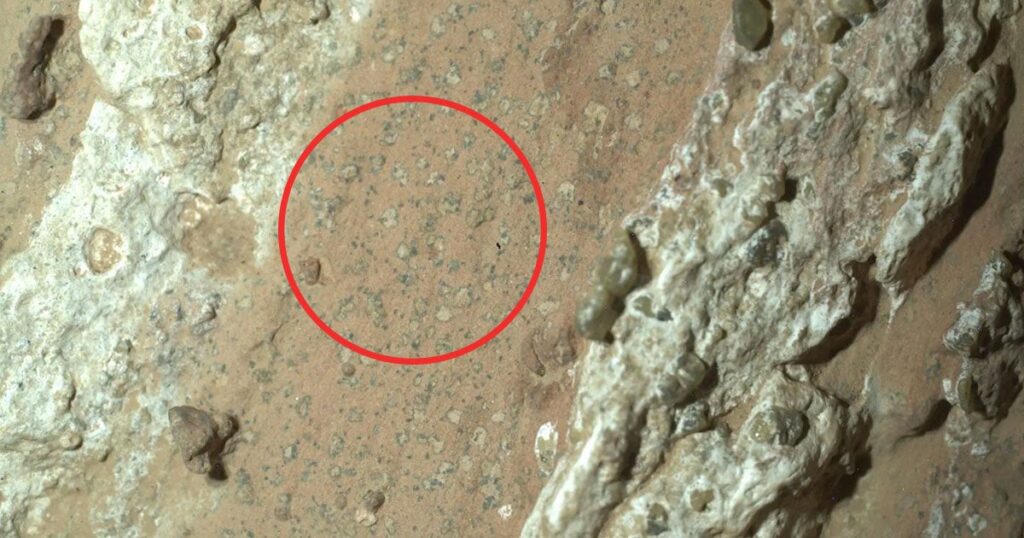

NASA has announced that its Perseverance Mars rover spotted “potential biosignatures” in an ancient dry riverbed last year.
Samples collected from a rock dubbed “Cheyava Falls” contain a structure that hints at the possibility of having a biological origin, according to the space agency, but more research needs to be completed to draw any conclusions about the presence of life on the Red Planet.
“The identification of a potential biosignature on the Red Planet is a groundbreaking discovery, and one that will advance our understanding of Mars,” said interim NASA administrator Sean Duffy in a statement, arguing this is the “closest we have ever come to discovering life on Mars.”
The rover first encountered the rock in July 2024 while exploring a rocky outcropping, called the Bright Angel rock formation, on the edge of an ancient river valley, which scientists believe was carved into the Martian surface by a rushing river billions of years ago.
Perseverance’s science instruments revealed layers of clay and silt, which are “excellent preservers of past microbial life” on Earth, according to NASA.
“The combination of chemical compounds we found in the Bright Angel formation could have been a rich source of energy for microbial metabolisms,” said Stony Brook University associate professor Joel Hurowitz, coauthor of a new paper published in the journal Nature about the finding, in the statement.
Despite the exciting findings, Hurowitz warned that it’s still far too early to draw any conclusions about “discovering life on Mars,” as Duffy put it, and scientists have yet to rule out abiotic, or non-living, explanations.
“But just because we saw all these compelling chemical signatures in the data didn’t mean we had a potential biosignature,” Hurowitz explained. “We needed to analyze what that data could mean.”
Mysterious, colorful spots on the Cheyava Falls rock had scientists intrigued. The spots could’ve been left behind by microbes billions of years ago, after turning organic carbon, sulfur, and phosphorus in the rock into energy.
Some of these “leopard spots” contained greigite, or iron sulfide, which certain Earth-based microbes can produce. They also contained vivianite, or hydrated iron phosphate, which is found near decaying organic matter on Earth.
“These reactions appear to have taken place shortly after the mud was deposited on the lake bottom,” Hurowitz told Reuters. “On Earth, reactions like these, which combine organic matter and chemical compounds in mud to form new minerals like vivianite and greigite, are often driven by the activity of microbes.”
In other words, scientists are hypothesizing that Martian microbial life could’ve left us an important clue of their existence eons ago.
Since the Cheyava Falls rock is younger compared to other closely examined Martian rocks, the finding could mean the planet was been habitable for much longer than previously believed.
“Astrobiological claims, particularly those related to the potential discovery of…
Source link
Disclaimer
We strive to uphold the highest ethical standards in all of our reporting and coverage. We blogs.grocliq.com want to be transparent with our readers about any potential conflicts of interest that may arise in our work. It’s possible that some of the investors we feature may have connections to other businesses, including competitors or companies we write about. However, we want to assure our readers that this will not have any impact on the integrity or impartiality of our reporting. We are committed to delivering accurate, unbiased news and information to our audience, and we will continue to uphold our ethics and principles in all of our work. Thank you for your trust and support.
Website Upgradation is going on for any glitch kindly connect at [email protected]