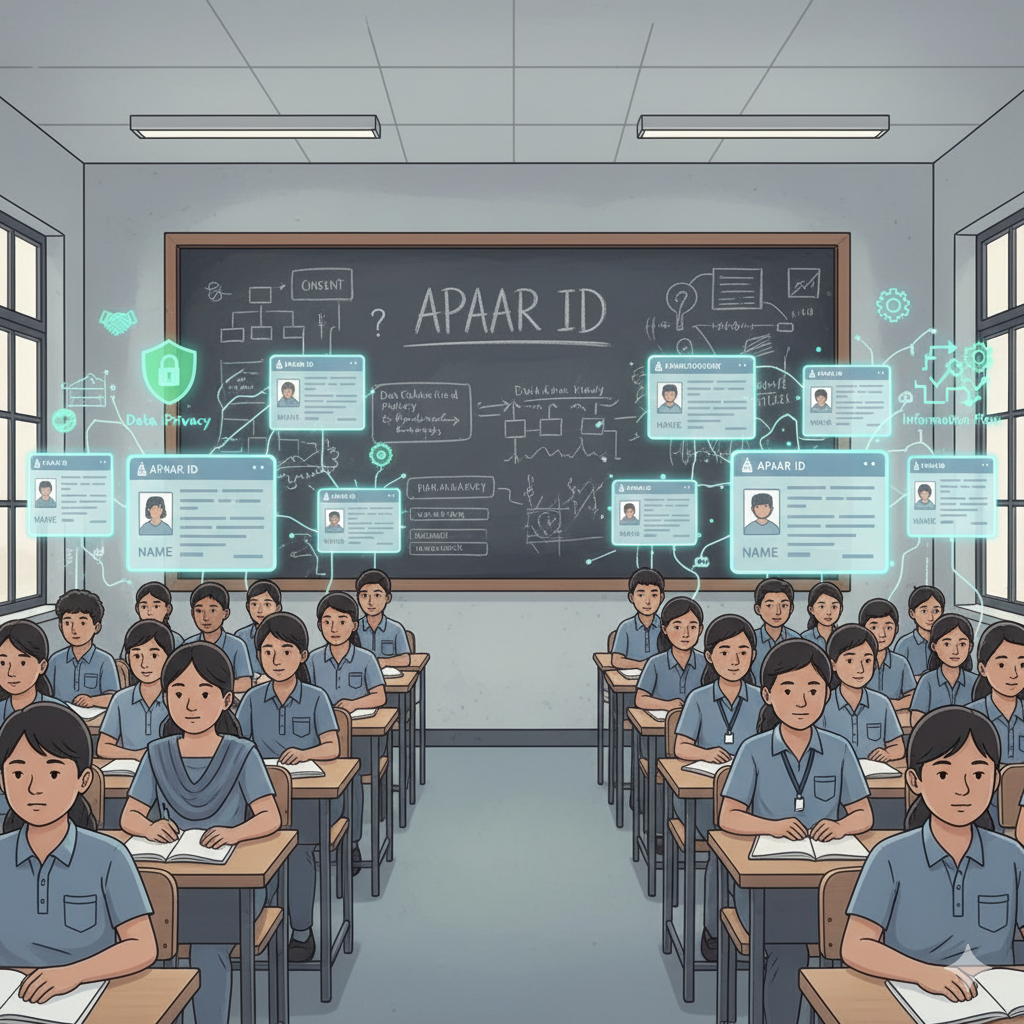

The Central Board of Secondary Education (CBSE) has partially relaxed the requirements to submit Automated Permanent Academic Account Registry (APAAR) IDs for the list of candidates for Class 10 and 12 board examinations.
The recent relaxation comes after CBSE received representations from schools across the country stating that they were facing technical and administrative challenges in generating APAAR IDs. These included difficulties in integration across different portals, discrepancies between a student’s data present with the school and in Aadhaar records, the time needed to complete the correction/update process, and a lack of parental consent. Given the time-bound nature of list submissions, CBSE has said that schools can submit student names without APAAR IDs in the following manner:
- Mark students whose parents refused to consent to APAAR IDs as “REFUSED” in the list. The school must submit a copy of the denial of consent form for these students.
- Mark students whose IDs the school couldn’t generate for other reasons as “NOGEN.”
What are APAAR IDs?
The Automated Permanent Academic Account Registry (APAAR) for students is part of the government’s One Nation, One Student programme. It creates an online repository of their academic records that students can access via the APAAR ID.
While the APAAR ID has always been voluntary on paper, reports suggest that schools have been mandating that parents consent to its creation. In January this year, CBSE released a circular stating that the APAAR ID will be the primary identifier of students in CBSE-affiliated schools in India.
Besides CBSE, state-level education boards have also pushed for APAAR enrolment. In January, the Uttar Pradesh Madhyamik Shiksha Parishad mandated that candidates would need to show their APAAR IDs along with their admit cards to enter the exam hall.
Why parents may be disinclined to consent to APAAR IDs:
During the consultation that eventually led to the APAAR ID mandate, stakeholders mentioned that a large number of parents may not be able to understand and manage the concept of digital data sharing, which would defeat the purpose of consent.
Some even questioned the need for a separate student ID when schools were already using Aadhaar. They argued that every digital ID and its associated transactions require teachers to make fresh data entries, taking away time they could spend on other activities.
Stakeholders also mentioned that a separate student ID could make students susceptible to surveillance. “Irrespective of the security systems, it is observed that data breaches happen, and therefore an additional digital ID for students seems unnecessary,” they added.
The questions around the utility of an additional ID, challenges with providing informed consent, and data security concerns could be reasons why parents may not consent to APAAR IDs.
Advertisements
Why CBSE’s partial relaxation may not be…
Source link
Disclaimer
We strive to uphold the highest ethical standards in all of our reporting and coverage. We blogs.grocliq.com want to be transparent with our readers about any potential conflicts of interest that may arise in our work. It’s possible that some of the investors we feature may have connections to other businesses, including competitors or companies we write about. However, we want to assure our readers that this will not have any impact on the integrity or impartiality of our reporting. We are committed to delivering accurate, unbiased news and information to our audience, and we will continue to uphold our ethics and principles in all of our work. Thank you for your trust and support.
Website Upgradation is going on for any glitch kindly connect at [email protected]