
Military history is littered with the corpses of apex predators.
The Gatling gun, the battleship, the tank. All once possessed unassailable power – then were undermined, in some cases wiped out, by the march of new technology.
“Speed and stealth and firepower,” the head of the Australian Submarine Agency, Jonathan Mead, told the Guardian two years ago of Australia’s forthcoming fleet of nuclear submarines. “The apex predator of the oceans.”
But for how much longer?
In the first quarter of the 21st century, nuclear submarines have proven a formidable force: essentially undetectable deadly attack weapons. Some also carry a vital “second-strike” deterrent effect: any attack on a country armed with nuclear-powered submarines is made with the knowledge that retaliation is certain – from a warship hidden beneath the waves.
But a drumbeat of declarations – much of it speculative but most of it from China, the very nation the Aukus pact was established to counter – report rapid developments in submarine-detection technologies: vast networks of acutely sensitive sonar arrays; quantum sensing; improved satellite tracking able to spot tiny perturbations in the ocean’s surface; technologies that detect minute disturbances in the Earth’s magnetic field; real-time AI processing of vast reams of data.
Could emerging technologies render the last opaque place on Earth – the oceans – transparent?
It may not be so binary, the oceans may become, in parts, less impenetrable: key contested sea lanes and littoral areas may be intensely surveilled, while remote, deep trenches remain arcane.
Forecasting a future conflict is fraught. But the consequences for Australia, having dedicated an extraordinary $368bn towards its Aukus nuclear submarine fleet, are immense: will the apex predator of today become the prey of tomorrow?
One brutal assessment put it in stark terms, Australia’s fleet of nuclear-powered submarines may end up being “billion-dollar coffins”.
Q&A
What is Aukus pillar one?
Show
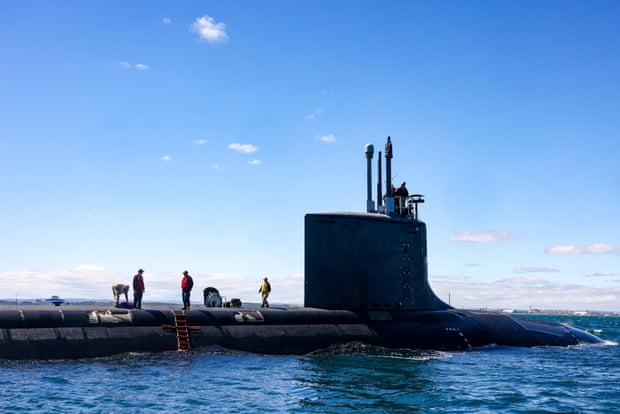
Pillar one of the Australia-UK-US (Aukus) agreement involves Australia being given the technology to command its own fleet of conventionally armed, nuclear-powered submarines. There are two stages:
• First, Australia will buy between three and five Virginia-class nuclear-powered submarines from the US, the first of these in 2032. But before any boat can be sold to Australia, the US commander-in-chief – the president of the day – must certify that the US relinquishing a submarine will not diminish its navy’s undersea capability. The US submarine fleet now has only three-quarters of the submarines it needs (49 boats of a force-level goal of 66). And there are significant concerns the US cannot build enough submarines for its own needs, let alone any for Australia.
• Second, by the “late 2030s”, according to the “optimal pathway” outlined in Australia’s submarine industry strategy, the UK will launch the first specifically designed and built Aukus…
Source link
Disclaimer
We strive to uphold the highest ethical standards in all of our reporting and coverage. We blogs.grocliq.com want to be transparent with our readers about any potential conflicts of interest that may arise in our work. It’s possible that some of the investors we feature may have connections to other businesses, including competitors or companies we write about. However, we want to assure our readers that this will not have any impact on the integrity or impartiality of our reporting. We are committed to delivering accurate, unbiased news and information to our audience, and we will continue to uphold our ethics and principles in all of our work. Thank you for your trust and support.
Website Upgradation is going on for any glitch kindly connect at [email protected]