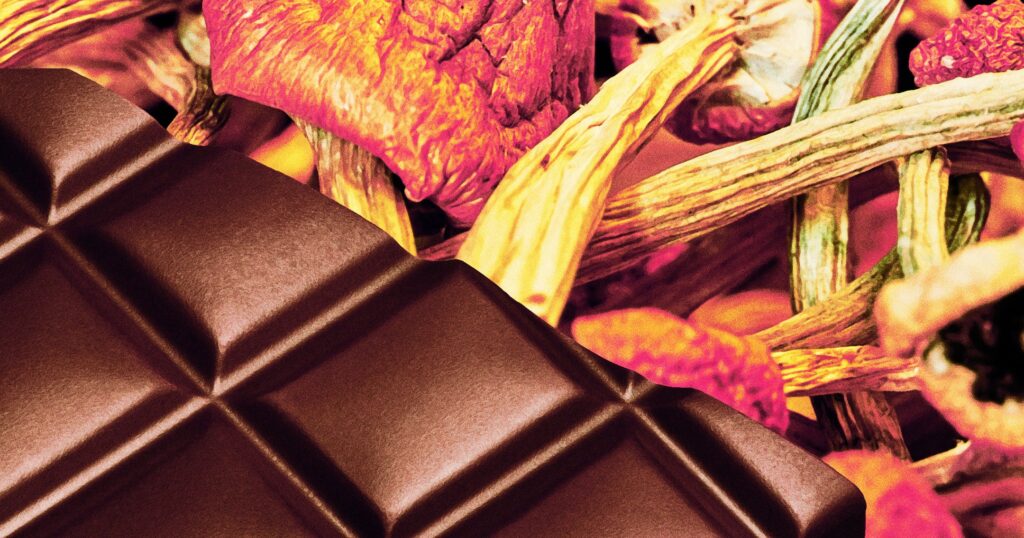

Image by Getty / Futurism
If you’re a coward and don’t want to munch on awful-tasting shrooms to go on a psychedelic odyssey, you can buy delicious edibles infused with their active ingredient instead: psilocybin.
But maybe you shouldn’t, because new research suggests that you might be getting ripped off taking these — or even putting your health at risk.
After testing 12 edible “magic mushroom” products sold in Portland, Oregon, Richard van Breemen and his colleagues found absolutely zero traces of psilocybin in any of them, they reported in a new study published in the journal JAMA Network Open. And four appeared to contain no active, trip-inducing ingredients at all.
“We found no evidence of mushroom compounds of any kind, coming from any species,” van Breemen, a pharmaceutical sciences professor at Oregon State University, told Scientific American.
Moreover, the researchers found ingredients that weren’t written on the label, including — alarmingly — synthetic psychedelics whose effects on human health aren’t well studied.
“We don’t know what harm they might cause,” van Breemen warned.
Psilocybin is touted for its trippy, recreational effects as much as it is for its purported mind-opening health benefits. Long illicit, some states like Oregon and New Mexico have in recent years moved to legalize or at least decriminalize the substance, but sometimes with the catch that they need to be administered in a supervised medical setting. And so outside those pricey official channels, loopholes allow shops to sell the psychedelic substance at cheap prices. This weird legal limbo has birthed a mini — and technically above-board — industry that peddles the drugs, but with little oversight.
“A lot of people are very curious about these substances,” Mason Marks, a law professor at Florida State University, told SciAm. “And if you’re in a state, like Oregon, that does not decriminalize them, people might go to these shops and buy these products that are either blatantly illegal or kind of in this gray area.”
That’s in a nutshell what van Breemen’s team did for the study: they went around Portland buying a host of magic mushroom edibles — mostly gummies but one chocolate — from gas stations and convenience stores.
Initial tests quickly established that none of these actually contained psilocybin. Then, by using mass spectrometry and a technique called liquid chromatography to separate the psychedelic snacks into their individual components, the team found that seven edibles had undisclosed ingredients like caffeine and THC, the drug that produces cannabis’ effects.
That’s noteworthy on its own, since it’s appalling to dose someone with something other than what they intended to take. The most disconcerting find, however, were two different synthetic psychedelic substances whose effects on human health have never been studied, mipracetin and 4-hydroxy-diethyltryptamine. That means oblivious customers, under the impression that they’re simply…
Source link
Disclaimer
We strive to uphold the highest ethical standards in all of our reporting and coverage. We blogs.grocliq.com want to be transparent with our readers about any potential conflicts of interest that may arise in our work. It’s possible that some of the investors we feature may have connections to other businesses, including competitors or companies we write about. However, we want to assure our readers that this will not have any impact on the integrity or impartiality of our reporting. We are committed to delivering accurate, unbiased news and information to our audience, and we will continue to uphold our ethics and principles in all of our work. Thank you for your trust and support.
Website Upgradation is going on for any glitch kindly connect at [email protected]