

Cybersecurity researchers have warned of a new campaign that’s leveraging a variant of the FileFix social engineering tactic to deliver the StealC information stealer malware.
“The observed campaign uses a highly convincing, multilingual phishing site (e.g., fake Facebook Security page), with anti-analysis techniques and advanced obfuscation to evade detection,” Acronis security researcher Eliad Kimhy said in a report shared with The Hacker News.
At a high level, the attack chain involves the use of FileFix to entice users into launching an initial payload that then proceeds to download seemingly innocuous images containing the malicious components from a Bitbucket repository. This allows the attackers to abuse the trust associated with a legitimate source code hosting platform to bypass detection.
FileFix, first documented by security researcher mrd0x as a proof-of-concept (PoC) in June 2025, is a little different from ClickFix in that it eschews the need for users to launch the Windows Run dialog and paste an already copied obfuscated command to complete bogus CAPTCHA verification checks on phishing pages set up for this purpose.

Instead, it leverages a web browser’s file upload feature to deceive users into copying and pasting a command on the File Explorer’s address bar, causing it to be executed locally on the victim’s machine.
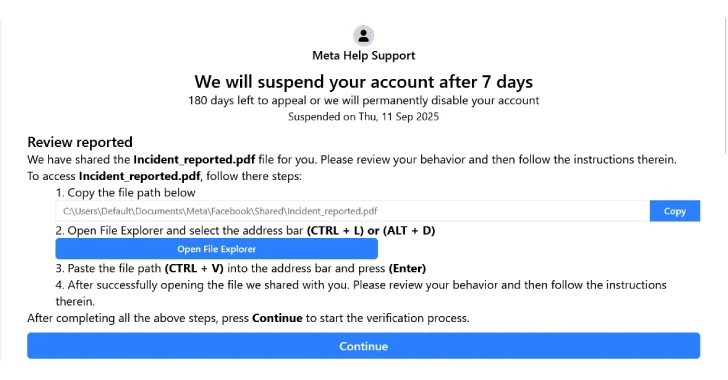
The attack commences with a phishing site to which the victim is likely redirected from an email message that warns recipients of potential suspension of their Facebook accounts after a week, claiming the shared posts or messages violate its policies. Users are then asked to appeal the decision by clicking on a button.
The phishing page is not only heavily obfuscated, but also resorts to techniques like junk code and fragmentation to hinder analysis efforts.
The FileFix attack comes into play once the button is clicked, at which point the victim is displayed a message stating they can access a PDF version of the supposed policy violation by copying and pasting a path to the document in the File Explorer’s address bar.
While the path provided in the instruction is completely harmless, a malicious command is surreptitiously copied to the user’s clipboard when they click on the button in the page to open File Explorer. This command is a multi-stage PowerShell script that downloads the aforementioned image, decodes it into the next-stage payload, and ultimately runs a Go-based loader that unpacks shellcode responsible for launching StealC.
FileFix also offers a crucial advantage over ClickFix, as it abuses a widely used browser feature as opposed to opening the Run dialog (or the Terminal app in case of Apple macOS), which could be blocked by a system administrator as a security measure.
“On the other hand, one of the things that makes ClickFix so challenging to detect in the first place is that it is spawned from Explorer.exe via the run dialog, or…
Source link
Disclaimer
We strive to uphold the highest ethical standards in all of our reporting and coverage. We blogs.grocliq.com want to be transparent with our readers about any potential conflicts of interest that may arise in our work. It’s possible that some of the investors we feature may have connections to other businesses, including competitors or companies we write about. However, we want to assure our readers that this will not have any impact on the integrity or impartiality of our reporting. We are committed to delivering accurate, unbiased news and information to our audience, and we will continue to uphold our ethics and principles in all of our work. Thank you for your trust and support.
Website Upgradation is going on for any glitch kindly connect at [email protected]