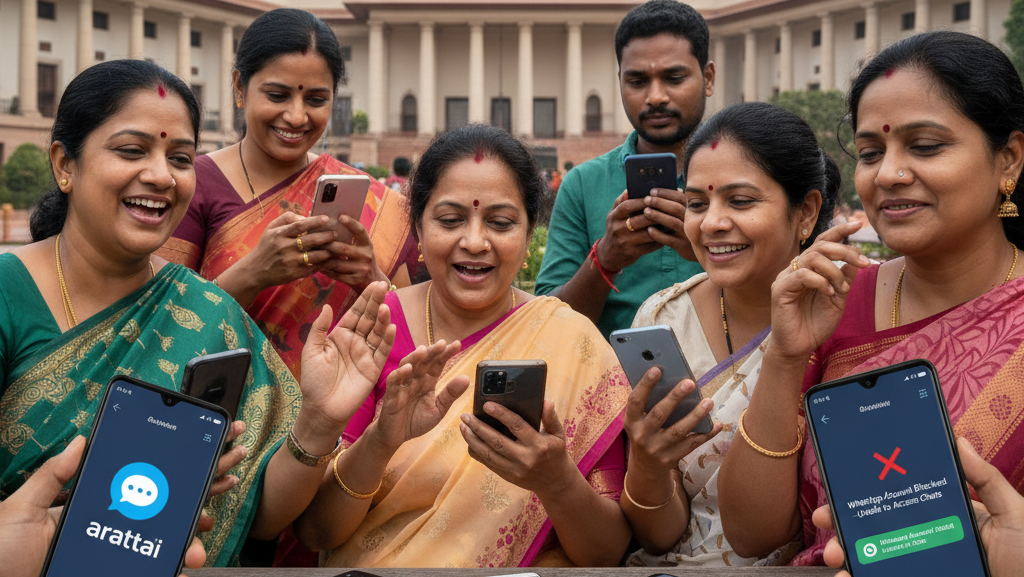

The Supreme Court has ruled that using WhatsApp is not a fundamental right, dismissing a plea filed by petitioners seeking restoration of their blocked accounts on the messaging platform, according to an NDTV report .
A bench of Justices Vikram Nath and Sandeep Mehta made the observation while hearing a petition filed under Article 32 of the Constitution, which allows individuals to move the apex court directly for the enforcement of fundamental rights.
“What is your fundamental right to have access to WhatsApp?”
During the hearing, Justice Nath questioned the petitioners’ decision to approach the top court, asking, “What is your fundamental right to have access to WhatsApp?” The bench noted that the plea did not raise any constitutional issue and advised the petitioners to pursue other legal remedies.
Senior advocate Mahalaxmi Pavani, representing the petitioners, said their clients, who work at a clinic and a polydiagnostic centre, had communicated with customers on WhatsApp for over a decade, but WhatsApp blocked their accounts without any prior notice or explanation.
She argued that the sudden suspension had disrupted their professional communication and requested the court to direct WhatsApp to restore their access.
“Use Arattai,” says Justice Mehta
Justice Mehta, however, remarked that there are alternative communication apps available. “There are other communication applications; you can use them. Recently, there’s this indigenous app called ‘Arattai’, use that. (It is) made in India,” said Justice Mehta
Growing Role of Arattai and Its Features
Arattai, launched by Chennai-based Zoho Corporation in 2021, has recently surged in popularity, briefly topping app store charts in India. Marketed as a “spyware-free, made-in-India messenger”, it has received endorsements from government officials under the Aatmanirbhar Bharat initiative, including Union Education Minister Dharmendra Pradhan and IT Minister Ashwini Vaishnaw.
The app offers key features like Voice over Internet Protocol (VoIP) calls, video calls, scheduling, status updates, and professional communication tools, making it a functional alternative to WhatsApp for both personal and professional use. One-to-one voice and video calls on Arattai are end-to-end encrypted, while text messages are encrypted in transit and at rest on servers. Full end-to-end encryption for text messages is under development.
Zoho is also planning to make Arattai interoperable with other messaging platforms in the future, aiming for an open ecosystem similar to India’s UPI system.
Arattai Adoption Challenges
Despite its growing user base, Arattai faces the challenge of network effects; users tend to stay on platforms already widely adopted, like WhatsApp. Past attempts at homegrown messaging apps, such as Hike and Koo, struggled to scale despite government promotion. Zoho’s approach, as co-founder Sridhar Vembu noted, allows them…
Source link
Disclaimer
We strive to uphold the highest ethical standards in all of our reporting and coverage. We blogs.grocliq.com want to be transparent with our readers about any potential conflicts of interest that may arise in our work. It’s possible that some of the investors we feature may have connections to other businesses, including competitors or companies we write about. However, we want to assure our readers that this will not have any impact on the integrity or impartiality of our reporting. We are committed to delivering accurate, unbiased news and information to our audience, and we will continue to uphold our ethics and principles in all of our work. Thank you for your trust and support.
Website Upgradation is going on for any glitch kindly connect at [email protected]