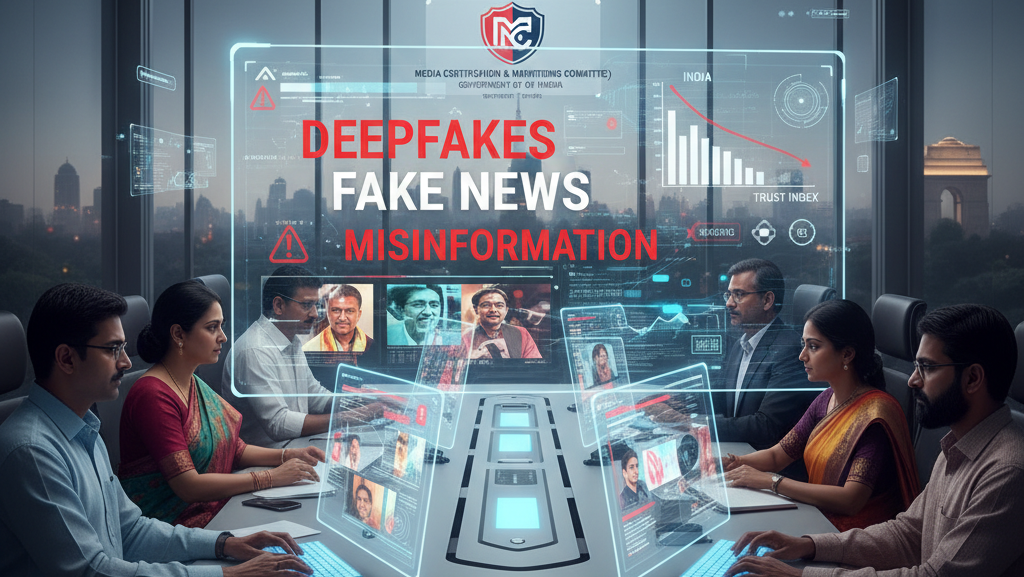

Recently, the Election Commission of India (ECI) issued a directive to all political parties, asking them to comply with the Model Code of Conduct (MCC) in the context of the upcoming general legislative assembly in Bihar and a few other constituencies. Among others, the Commission advised all the political parties against using AI tools to create deepfakes or spread misinformation, stressing the need to protect the integrity of the electoral process. While this directive calls for the precautionary measures that the political parties and leaders are supposed to take to ensure “integrity of the electoral process,” the directive doesn’t explain what kind of content will be taken down and its process.
According to the press release (archive) sent by ECI in June 2024, the social media platforms have to remove the fake content, including deepfakes, misinformation and synthetic content, within three hours of notifying the platforms. However, neither ECI’s Handbook on Media Matters nor the guidelines mentions how to identify and confirm whether the flagged content is fake news or not. The ECI has the guidance on how to identify fake news through Social Media Experts of the Media Certification and Monitoring Committee (MCMC), a body constituted to certify the political advertisements.
However, authorities currently provide no clear definition or specification of what constitutes a deepfake and how to regulate it. While guidelines exist for paid news and related content, regulators still lack clarity and rules for deepfakes and generative AI (GenAI) content.
Why do the Take Downs Matter?
To illustrate the rising takedown orders, especially during the election period, we can look at the content take own orders during 2019’s general elections, social media platforms, including Facebook, Twitter, and WhatsApp, removed more than 900 posts. While Facebook took down 650 posts, Twitter deleted 220 tweets, and ShareChat removed 31 posts. Additionally, five YouTube videos were taken down, and three WhatsApp accounts were disabled. It is important to note that in the same year, an industry body, the Internet and Mobile Association of India, submitted a Voluntary Code of Ethics, which ECI refers to in its documentation for media regulation and governance during the elections.
Similarly, the Ministry of Home Affairs’ Indian Cyber Crime Coordination Centre (I4C) has issued 426 content takedown notices to online platforms since it became responsible for flagging unlawful online activity in March 2024. In total, the I4C asked platforms to remove over 1.10 lakh URLs and accounts from their services.
The highest number of notices, 78, were sent to WhatsApp, directing the removal of 83,673 accounts or groups. This figure closely resembles the 83,668 WhatsApp account takedowns that the Ministry previously linked to digital arrest scams in Parliament. The second-largest number of notices, 73, were sent to Instagram, seeking the…
Source link
Disclaimer
We strive to uphold the highest ethical standards in all of our reporting and coverage. We blogs.grocliq.com want to be transparent with our readers about any potential conflicts of interest that may arise in our work. It’s possible that some of the investors we feature may have connections to other businesses, including competitors or companies we write about. However, we want to assure our readers that this will not have any impact on the integrity or impartiality of our reporting. We are committed to delivering accurate, unbiased news and information to our audience, and we will continue to uphold our ethics and principles in all of our work. Thank you for your trust and support.
Website Upgradation is going on for any glitch kindly connect at [email protected]