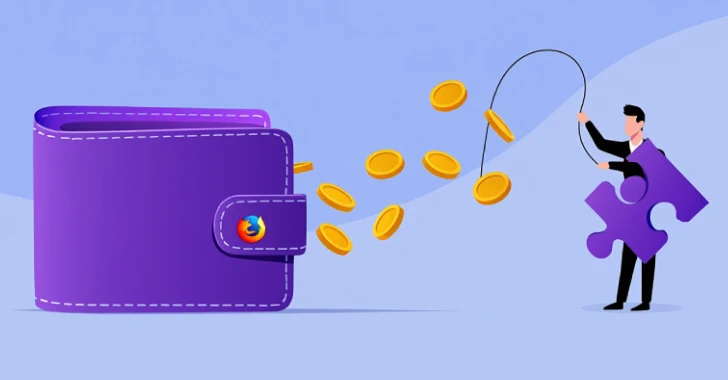


A newly discovered campaign dubbed GreedyBear has leveraged over 150 malicious extensions to the Firefox marketplace that are designed to impersonate popular cryptocurrency wallets and steal more than $1 million in digital assets.
The published browser add-ons masquerade as MetaMask, TronLink, Exodus, and Rabby Wallet, among others, Koi Security researcher Tuval Admoni said.
What makes the activity notable is the threat actor’s use of a technique that the cybersecurity company called Extension Hollowing to bypass safeguards put in place by Mozilla and exploit user trust. It’s worth noting that some aspects of the campaign were first documented by security researcher Lukasz Olejnik last week.
“Rather than trying to sneak malicious extensions past initial reviews, they build legitimate-seeming extension portfolios first, then weaponize them later when nobody’s watching,” Admoni said in a report published Thursday.
To achieve this, the attackers first create a publisher account in the marketplace, upload innocuous extensions with no actual functionality to sidestep initial reviews, post fake positive reviews to create an illusion of credibility, and modify their innards with malicious capabilities.

The fake extensions are designed to capture wallet credentials entered by unsuspecting users and exfiltrate them to an attacker-controlled server. It also gathers victims’ IP addresses for likely tracking purposes.
The campaign is assessed to be an extension of a previous iteration called Foxy Wallet that involved the threat actors publishing no less than 40 malicious browser extensions for Mozilla Firefox with similar goals in mind. The latest spike in the number of extensions indicates the growing scale of the operation.
The fake wallet cryptocurrency draining attacks are augmented by campaigns that distribute malicious executables through various Russian sites that peddle cracked and pirated software, leading to the deployment of information stealers and even ransomware.
The GreedyBear actors have also found setting up scam sites that pose as cryptocurrency products and services, such as wallet repair tools, to possibly trick users into parting with their wallet credentials, or payment details, resulting in credential theft and financial fraud.
Koi Security said it was able to link the three attack verticals to a single threat actor based on the fact that the domains used in these efforts all point to a lone IP address: 185.208.156[.]66, which acts as a command-and-control (C2) server for data collection and management.

There is evidence to suggest that the extension-related attacks are branching out to target other browser marketplaces. This is based on the discovery of a Google Chrome extension named Filecoin Wallet that has used the same C2 server and the underlying logic to pilfer credentials.
To make matters worse, an analysis of the artifacts has uncovered signs that they may have been created using artificial intelligence (AI)-powered…
Source link
Disclaimer
We strive to uphold the highest ethical standards in all of our reporting and coverage. We blogs.grocliq.com want to be transparent with our readers about any potential conflicts of interest that may arise in our work. It’s possible that some of the investors we feature may have connections to other businesses, including competitors or companies we write about. However, we want to assure our readers that this will not have any impact on the integrity or impartiality of our reporting. We are committed to delivering accurate, unbiased news and information to our audience, and we will continue to uphold our ethics and principles in all of our work. Thank you for your trust and support.
Website Upgradation is going on for any glitch kindly connect at [email protected]