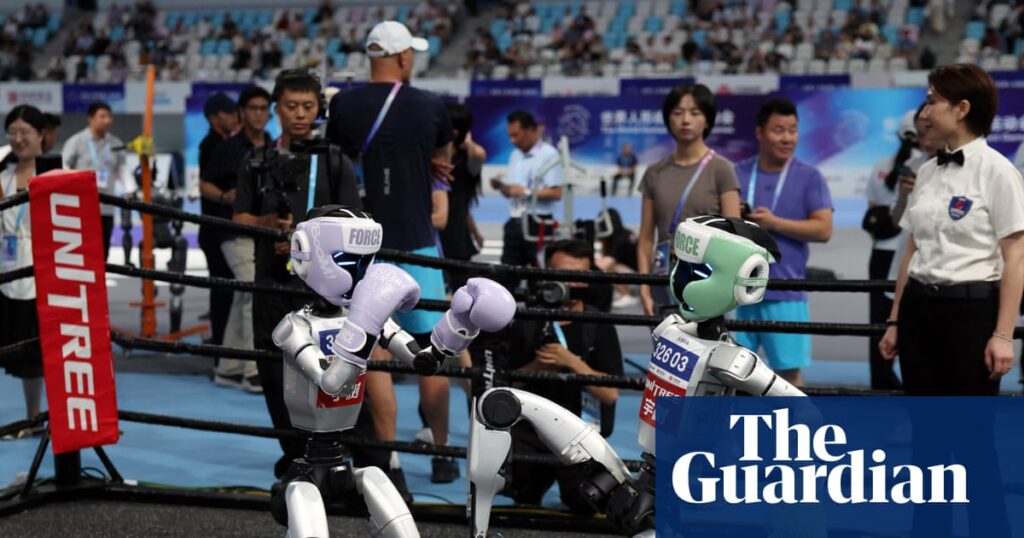

A quick left hook, a front kick to the chest, a few criss-cross jabs, and the crowd cheers. But it is not kickboxing prowess that concludes the match. It is an attempted roundhouse kick that squarely misses its target, sending the kickboxer from a top university team tumbling to the floor.
While traditional kickboxing comes with the risk of blood, sweat and serious head injuries, the competitors in Friday’s match at the inaugural World Humanoid Robot Games in Beijing faced a different set of challenges. Balance, battery life and a sense of philosophical purpose being among them.
The kickboxers, pint-sized humanoid robots entered by teams from leading Chinese technological universities, are part of a jamboree of humanoid events taking place at China’s latest technology event. After spectators in the 12,000-seater National Speed Skating Oval, built for the 2022 Winter Olympics, stood for the Chinese national anthem on Friday morning, the government-backed games began.
“I came here out of curiosity,” said Hong Yun, a 58-year-old retired engineer, sat in the front row. Seeing the robots race was “much more exciting than seeing real humans”, Hong added.
The games put on display China’s prowess in humanoid robotics, a technological field that has been pushed to the forefront of the country’s artificial intelligence industry. The hype machine is in full swing.
As well as kickboxing, humanoids participated in athletics, football and dance competitions. One robot had to drop out of the 1500-metre because its head flew off partway round the course. “Keeping [the head] balanced while in movement is the biggest challenge for us,” said Wang Ziyi, a 19-year-old student from Beijing Union University, who was part of the team that entered the robot.
Ever since a troupe of humanoid dancing robots took the stage at the 2025 Spring Festival Gala, a televised lunar new year’s celebration viewed nearly 17bn times online, Beijing has been enthusiastically pushing the adoption of “embodied AI” – an industry that was singled out in this year’s government work report in March.
The social-media-friendly events reflect a more serious geopolitical reality: an intensifying US-China technological competition that could reshape the frontiers of AI.
The technology has become a lightning rod for relations between the two countries. And while the US still has the lead on frontier research, owing in part to Washington’s restrictions on the export of cutting-edge chips to China, Beijing is going all-in on real life applications, such as robotics.
Several cities, including Beijing and Shanghai, have established 10bn yuan (£1bn) robotics industry funds. In January, the state-owned Bank of China…
Source link
Disclaimer
We strive to uphold the highest ethical standards in all of our reporting and coverage. We blogs.grocliq.com want to be transparent with our readers about any potential conflicts of interest that may arise in our work. It’s possible that some of the investors we feature may have connections to other businesses, including competitors or companies we write about. However, we want to assure our readers that this will not have any impact on the integrity or impartiality of our reporting. We are committed to delivering accurate, unbiased news and information to our audience, and we will continue to uphold our ethics and principles in all of our work. Thank you for your trust and support.
Website Upgradation is going on for any glitch kindly connect at [email protected]