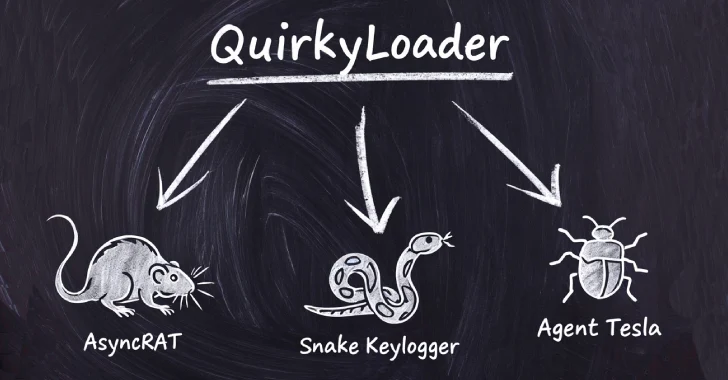


Cybersecurity researchers have disclosed details of a new malware loader called QuirkyLoader that’s being used to deliver via email spam campaigns an array of next-stage payloads ranging from information stealers to remote access trojans since November 2024.
Some of the notable malware families distributed using QuirkyLoader include Agent Tesla, AsyncRAT, Formbook, Masslogger, Remcos RAT, Rhadamanthys Stealer, and Snake Keylogger.
IBM X-Force, which detailed the malware, said the attacks involve sending spam emails from both legitimate email service providers and a self-hosted email server. These emails feature a malicious archive, which contains a DLL, an encrypted payload, and a real executable.
“The actor uses DLL side-loading, a technique where launching the legitimate executable also loads the malicious DLL,” security researcher Raymond Joseph Alfonso said. “This DLL, in turn, loads, decrypts, and injects the final payload into its target process.”

This is achieved by using process hollowing to inject the malware into one of the three processes: AddInProcess32.exe, InstallUtil.exe, or aspnet_wp.exe.
The DLL loader, per IBM, has been used in limited campaigns for the past few months, with two campaigns observed in July 2025 targeting Taiwan and Mexico.
The campaign targeting Taiwan is said to have specifically singled out employees of Nusoft Taiwan, a network and internet security research company based in New Taipei City, with the goal of infecting them with Snake Keylogger, which is capable of stealing sensitive information from popular web browsers, keystrokes, and clipboard content.

The Mexico-related campaign, on the other hand, is assessed to be random, with the infection chains delivering Remcos RAT and AsyncRAT.
“The threat actor consistently writes the DLL loader module in .NET languages and uses ahead-of-time (AOT) compilation,” Alfonso said. “This process compiles the code into native machine code before execution, making the resulting binary appear as though it were written in C or C++.”
New Phishing Trends
The development comes as threat actors are using new QR code phishing (aka quishing) tactics like splitting malicious QR codes into two parts or embedding them within legitimate ones in email messages propagated via phishing kits like Gabagool and Tycoon, respectively, to evade detection, demonstrating ongoing evolution.
“Malicious QR codes are popular with attackers for several reasons,” Barracuda researcher Rohit Suresh Kanase said. “They cannot be read by humans so don’t raise any red flags, and they can often bypass traditional security measures such as email filters and link scanners.”
“Furthermore, since recipients often have to switch to a mobile device to scan the code, it can take users out of the company security perimeter and away from protection.”

The findings also follow the emergence of a phishing kit used by the PoisonSeed threat actor to…
Source link
Disclaimer
We strive to uphold the highest ethical standards in all of our reporting and coverage. We blogs.grocliq.com want to be transparent with our readers about any potential conflicts of interest that may arise in our work. It’s possible that some of the investors we feature may have connections to other businesses, including competitors or companies we write about. However, we want to assure our readers that this will not have any impact on the integrity or impartiality of our reporting. We are committed to delivering accurate, unbiased news and information to our audience, and we will continue to uphold our ethics and principles in all of our work. Thank you for your trust and support.
Website Upgradation is going on for any glitch kindly connect at [email protected]