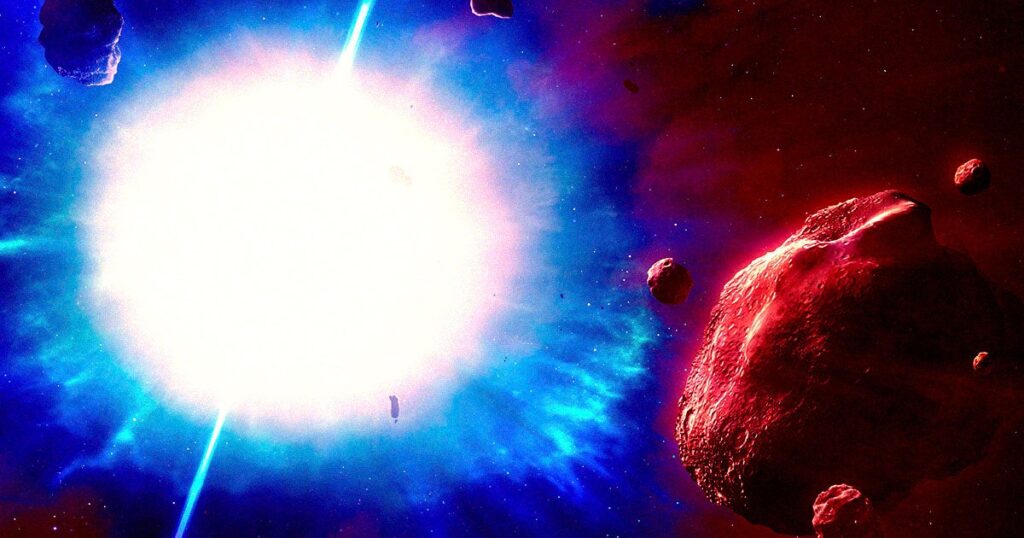

For almost two decades, astronomers have been trying in vain to explain extremely bright flashes of radio bursts emanating from deep space.
Despite only lighting up for a tiny fraction of a second, these fast radio bursts (FRBs) have been known to release as much energy as the Sun puts out in an entire year.
Now, in what’s being called a “turning point,” an international team of researchers has traced back the location of the origin of one of the brightest FRBs ever detected, allowing them to glean invaluable insights into the baffling phenomenon.
As detailed in a pair of new papers, astronomers used the Canadian CHIME/FRB radio-telescope to home in on an FRB, officially called 20250316A — but unofficially referred to as “RBFLOAT” for Radio Brightest Flash Of All Time” — which was first observed in March of this year near the Big Dipper.
Thanks to an array of “outrigger” telescopes spread out across North America, the team was able to pinpoint the origin of the FRB to a precise region that measures just 45 light-years across, significantly smaller than the average star cluster, in a galaxy some 130 million light-years away.
While that may sound somewhat overwhelming, given the fact that 45 light-years is roughly 30 times the diameter of our entire solar system, it’s an impressive feat.
“The precision of this localization, tens of milliarcseconds, is like spotting a quarter from [62 miles] away,” said lead author of one of the papers and McGill University-based postdoctoral researcher Amanda Cook in a statement. “That level of detail is what let us identify the host galaxy, NGC 4141, and match the burst with a faint infrared signal captured by the James Webb Space Telescope.”
That kind of precision allowed teams to trace back the FRB’s origin to a faint infrared signal, which was previously captured by NASA’s James Webb Space Telescope.
“The high resolution of JWST allows us to resolve individual stars around an FRB for the first time,” said Harvard research associate Peter Blanchard, lead author of the second paper, in the statement. “This opens the door to identifying the kinds of stellar environments that could give rise to such powerful bursts, especially when rare FRBs are captured with this level of detail.”
“This was a unique opportunity to quickly turn JWST’s powerful infrared eye on the location of an FRB for the first time,” he added in a separate Harvard press release, calling the faint infrared source an “exciting result.”
“This could be the first object linked to an FRB that anyone has found in another galaxy,” Blanchard said.
Despite the exciting advancement, we’re still far from calling the mystery solved once and for all.
Researchers have previously suggested that magnetars, the extremely dense and highly magnetized remains of dead stars, or neutron stars, could be causing FRBs, sending powerful flashes of radio emissions at regular intervals like a lighthouse.
And that’s just one of many candidates that have been put forward over the…
Source link
Disclaimer
We strive to uphold the highest ethical standards in all of our reporting and coverage. We blogs.grocliq.com want to be transparent with our readers about any potential conflicts of interest that may arise in our work. It’s possible that some of the investors we feature may have connections to other businesses, including competitors or companies we write about. However, we want to assure our readers that this will not have any impact on the integrity or impartiality of our reporting. We are committed to delivering accurate, unbiased news and information to our audience, and we will continue to uphold our ethics and principles in all of our work. Thank you for your trust and support.
Website Upgradation is going on for any glitch kindly connect at [email protected]