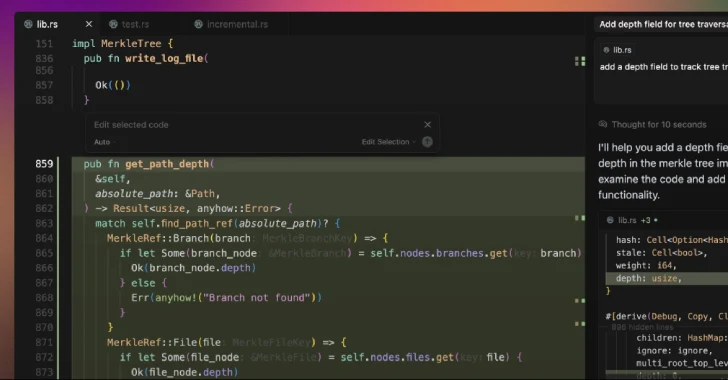


A security weakness has been disclosed in the artificial intelligence (AI)-powered code editor Cursor that could trigger code execution when a maliciously crafted repository is opened using the program.
The issue stems from the fact that an out-of-the-box security setting is disabled by default, opening the door for attackers to run arbitrary code on users’ computers with their privileges.
“Cursor ships with Workspace Trust disabled by default, so VS Code-style tasks configured with runOptions.runOn: ‘folderOpen’ auto-execute the moment a developer browses a project,” Oasis Security said in an analysis. “A malicious .vscode/tasks.json turns a casual ‘open folder’ into silent code execution in the user’s context.”
Cursor is an AI-powered fork of Visual Studio Code, which supports a feature called Workspace Trust to allow developers to safely browse and edit code regardless of where it came from or who wrote it.
With this option disabled, an attacker can make available a project in GitHub (or any platform) and include a hidden “autorun” instruction that instructs the IDE to execute a task as soon as a folder is opened, causing malicious code to be executed when the victim attempts to browse the booby-trapped repository in Cursor.
“This has the potential to leak sensitive credentials, modify files, or serve as a vector for broader system compromise, placing Cursor users at significant risk from supply chain attacks,” Oasis Security researcher Erez Schwartz said.
To counter this threat, users are advised to enable Workplace Trust in Cursor, open untrusted repositories in a different code editor, and audit them before opening them in the tool.

The development comes as prompt injections and jailbreaks have emerged as a stealthy and systemic threat plaguing AI-powered coding and reasoning agents like Claude Code, Cline, K2 Think, and Windsurf, allowing threat actors to embed malicious instructions in sneaky ways to trick the systems into performing malicious actions or leaking data from software development environments.
Software supply chain security outfit Checkmarx, in a report last week, revealed how Anthropic’s newly introduced automated security reviews in Claude Code could inadvertently expose projects to security risks, including instructing it to ignore vulnerable code through prompt injections, causing developers to push malicious or insecure code past security reviews.
“In this case, a carefully written comment can convince Claude that even plainly dangerous code is completely safe,” the company said. “The end result: a developer – whether malicious or just trying to shut Claude up – can easily trick Claude into thinking a vulnerability is safe.”
Another problem is that the AI inspection process also generates and executes test cases, which could lead to a scenario where malicious code is run against production databases if Claude Code isn’t properly sandboxed.

The AI company, which also recently launched a new file creation and…
Source link
Disclaimer
We strive to uphold the highest ethical standards in all of our reporting and coverage. We blogs.grocliq.com want to be transparent with our readers about any potential conflicts of interest that may arise in our work. It’s possible that some of the investors we feature may have connections to other businesses, including competitors or companies we write about. However, we want to assure our readers that this will not have any impact on the integrity or impartiality of our reporting. We are committed to delivering accurate, unbiased news and information to our audience, and we will continue to uphold our ethics and principles in all of our work. Thank you for your trust and support.
Website Upgradation is going on for any glitch kindly connect at [email protected]