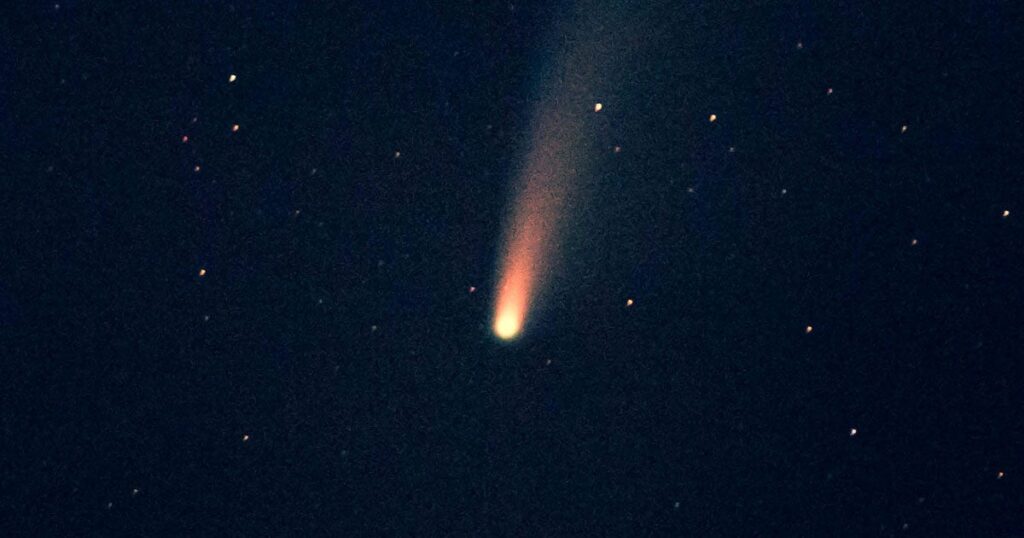

A mysterious object from interstellar space is screaming through our solar system right now, and is expected to rip past Mars and Jupiter over the coming months before exiting back into the void between stars.
Astronomers have been fascinated by the unusual visitor, dubbed 3I/ATLAS after its discovery in July, and have broadly come to the conclusion that it’s a comet comprised of ice and dust particles.
As the object approaches its closest point to our Sun, its activity is steadily picking up as it’s believed to be shedding gases and dust, giving it a growing tail.
And intriguingly, according to images taken by NASA’s Hubble Space Telescope, the object isn’t just growing one tail — it’s also sprouting a separate “anti-tail,” pointing in the direction of the Sun, as Harvard astronomer Avi Loeb suggests in a new, yet-to-be-peer-reviewed paper.
“The anti-tail is an extension of the glow of scattered sunlight around 3I/ATLAS towards the Sun and not away from it — as typically the case for comets,” Loeb explained in a new blog post. “This anomalous anti-tail, not a result of geometric perspective, had never been reported before for solar system comets.”
Loeb and fellow Harvard astrophysicist Eric Keto suggest this anti-tail could be the result of ice fragments being shed from 3I/ATLAS’ surface instead of “refractory dust particles as previously assumed.”
This strange new appendage “represents an extension of the snow line, or survival distance of a sublimating ice grain, in the direction of the Sun,” Loeb suggests.
The researchers determined that while most of 3I/ATLAS’ mass is made up of carbon dioxide, the “longest-surviving grains are mostly made of water (H2O) ice, which evaporates more slowly than carbon dioxide.”
“The ice fragments evaporate after some time but because of the enhanced mass loss in the Sun-facing side, more of the bigger fragments can reach a large distance,” Loeb told Futurism in an email, “giving rise to an anti-tail namely a glow that is extended towards the Sun.”
Astronomers examining the object using numerous high-powered space telescopes including NASA’s James Webb previously found that the object’s coma, or the gas and dust surrounding its nucleus, features a much higher ratio of carbon dioxide to water than expected.
The fleeting visitor was also observed changing color, from red to a blue-green glow, indicating a “steep rise in the production of cyanide” in the absence of iron, as Loeb suggested in a previous blog post.
“Natural comets generically show iron and nickel simultaneously, as both elements are produced together in the ejecta of supernova explosions,” Loeb wrote in a blog post last month.
Loeb’s most headline-grabbing claims around the object have invoked the possibility that 3I/ATLAS could’ve been sent to us by an extraterrestrial civilization. But the more data comes in, the more likely it is that we’re looking at a comet, not an artifact from an alien species.
Still, it’s a fascinating visitor — and just the…
Source link
Disclaimer
We strive to uphold the highest ethical standards in all of our reporting and coverage. We blogs.grocliq.com want to be transparent with our readers about any potential conflicts of interest that may arise in our work. It’s possible that some of the investors we feature may have connections to other businesses, including competitors or companies we write about. However, we want to assure our readers that this will not have any impact on the integrity or impartiality of our reporting. We are committed to delivering accurate, unbiased news and information to our audience, and we will continue to uphold our ethics and principles in all of our work. Thank you for your trust and support.
Website Upgradation is going on for any glitch kindly connect at [email protected]