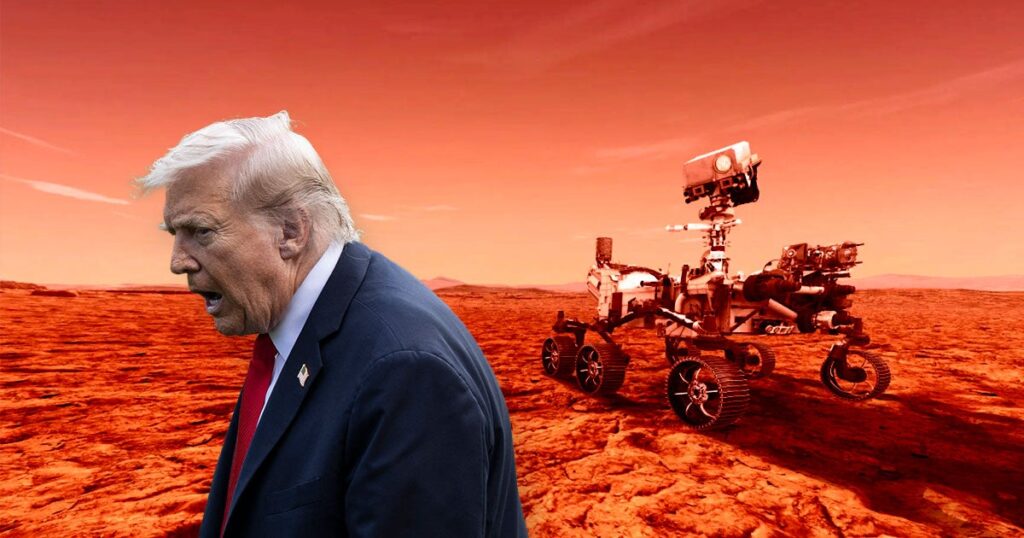

NASA’s interim leader Sean Duffy didn’t make it through a single sentence in his announcement that the agency’s Mars Perseverance rover had spotted “potential biosignatures” on the Red Planet last year without sucking up to president Donald Trump.
While we’re still far from a definitive conclusion about current or ancient life on Mars, it was an exciting finding, with a sampled rock containing minerals closely associated with Earth-based microbial life.
The only problem? The Trump administration has made it clear that it’s not interested in returning the samples taken by NASA’s Perseverance rover back to Earth for laboratory analysis.
The agency’s Mars Sample Return mission had been a hot-button topic for years, with lawmakers balking at the proposed plan’s astronomical price tag of $11 billion. But the Trump administration wants to nix the mission altogether in its potentially devastating 2026 budget proposal, alongside dozens of other planetary science missions.
In other words, as much as Duffy glazes Trump publicly, in reality, Trump is our planet’s number one obstacle to following up on NASA’s blockbuster findings about life on Mars.
As Ars Technica reports, Duffy had very little to add when needled by reporters this week about the Trump administration’s commitment to returning the Mars samples, clumsily avoiding making any promises.
“What we’re going to do is look at our budget, so we look at our timing, and you know, how do we spend money better?” he told one reporter. “And you know, what technology do we have to get samples back more quickly? And so that’s a current analysis that’s happening right now.”
Duffy also reiterated that the Trump administration was pouring all of its resources into sending “our boots to the Moon and to Mars” — efforts that would be far more complex, expensive, and time-intensive than a sample return mission. (And that’s if sending astronauts to the Red Planet is even feasible in the first place.)
To experts, canceling the Mars Sample Return mission would be an enormous and costly mistake.
“Our understanding of Mars has gotten to the point that the questions we’re asking can best be addressed with returned samples,” University of Colorado Boulder senior research scientist Bruce Jakosky told Space.com earlier this year.
“To decide not to return them, or to put it off to an indefinite future time with human missions would be to take a major step back in exploring the solar system and the universe and in continuing to develop our scientific understanding of the world around us,” he added.
Jakosky also explained that such a mission could lay important groundwork for future crewed missions to the Red Planet, and “allow us to solve important problems in planetary protection so that we don’t put the Earth at risk from possible Martian microbes.”
Instead, the Trump administration wants to award the private space industry $1 billion to send the first humans to Mars.
What that plan looks like remains uncertain as ever — but…
Source link
Disclaimer
We strive to uphold the highest ethical standards in all of our reporting and coverage. We blogs.grocliq.com want to be transparent with our readers about any potential conflicts of interest that may arise in our work. It’s possible that some of the investors we feature may have connections to other businesses, including competitors or companies we write about. However, we want to assure our readers that this will not have any impact on the integrity or impartiality of our reporting. We are committed to delivering accurate, unbiased news and information to our audience, and we will continue to uphold our ethics and principles in all of our work. Thank you for your trust and support.
Website Upgradation is going on for any glitch kindly connect at [email protected]