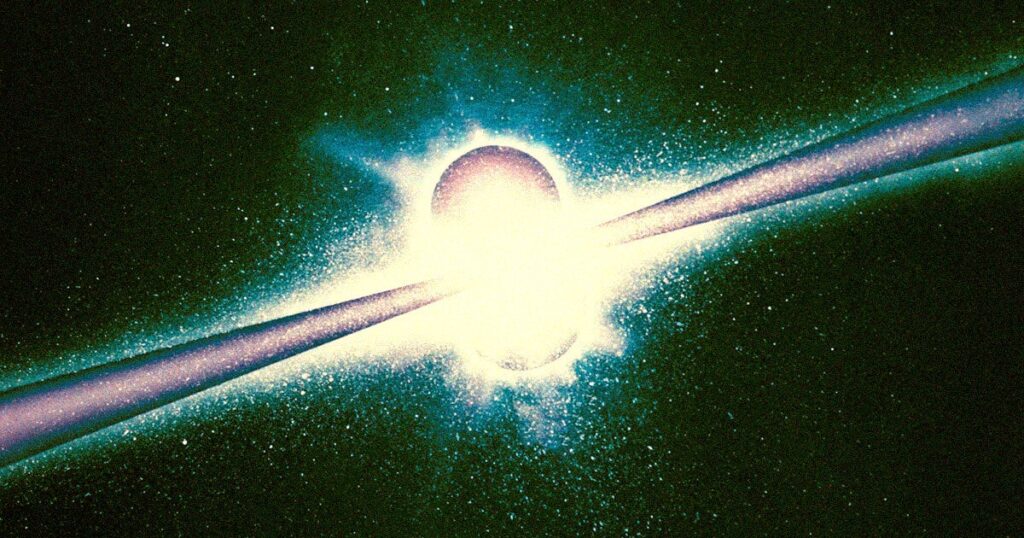

Gamma ray bursts are some of the most powerful explosions in the universe, unleashing as much energy in mere seconds as the Sun will in its entire 10 billion year lifespan. Typically, they’re produced by stars dying in a spectacular supernova — a rapid collapse that completely obliterates the stellar object.
But now, astronomers say they’ve detected a gamma ray burst that utterly defies explanation: it repeated multiple times over the course of a single day, as if the star somehow suffered back-to-back — and back — deaths.
“This event is unlike any other seen in 50-years of GRB observations,” Antonio Martin-Carrillo, an astronomer at University College Dublin, Ireland, and coauthor of a new study published in The Astrophysical Journal Letters detailing the detection, said in a statement.
“GRBs are catastrophic events, so they are expected to go off just once because the source that produced them does not survive the dramatic explosion,” he emphasized.
The signal’s existence is so stunning that no known scenario can fully explain the GRB, according to a release from the European Southern Observatory. How can a star suffer an explosion that should completely obliterate it multiple times?
First, let’s consider how stars die. When a massive one at least several times heavier than the Sun burns through all its fuel, it near-instantly collapses under its own gravity in a supernova, which blows the stars to smithereens and blasts its scattered remains into space.
But not all supernovas are the same. Some occur in binary star systems that contain a super-dense stellar remnant called a white dwarf and an ordinary star. If their orbits get too close, the white dwarf begins to siphon huge amounts of material from its companion. When enough of the stolen stuff accumulates on the white dwarf’s surface, it triggers an epic thermonuclear explosion that destroys both stars.
Astronomers have spotted a star exploding multiple times before — in this same white dwarf scenario, in fact. Instead of instantly resulting in a supernova, however, the pairs’ explosive death is preceded by a smaller blast caused by a cloud of some of the siphoned helium.
But that type of scenario wouldn’t produce a double — let alone triple — GRB, since only one of those blasts is a supernova proper.
And so this latest explosion, designated GRB 250702B, appears to be altogether something different. Scientists first took notice when it was detected on July 2 by NASA’s Fermi Gamma-ray Space Telescope. In all, Fermi detected three distinctive bursts. Later, the astronomers realized that another observatory, the x-ray telescope called the Einstein Probe, had picked up the activity almost an entire day earlier.
“This is 100-1000 times longer than most GRBs,” said co-lead author and Radboud University astronomer Andrew Levan in the statement.
More than that, it also appeared to be periodic, Martin-Carrillo added, which has also never been seen before.
The original suspicion was that…
Source link
Disclaimer
We strive to uphold the highest ethical standards in all of our reporting and coverage. We blogs.grocliq.com want to be transparent with our readers about any potential conflicts of interest that may arise in our work. It’s possible that some of the investors we feature may have connections to other businesses, including competitors or companies we write about. However, we want to assure our readers that this will not have any impact on the integrity or impartiality of our reporting. We are committed to delivering accurate, unbiased news and information to our audience, and we will continue to uphold our ethics and principles in all of our work. Thank you for your trust and support.
Website Upgradation is going on for any glitch kindly connect at [email protected]