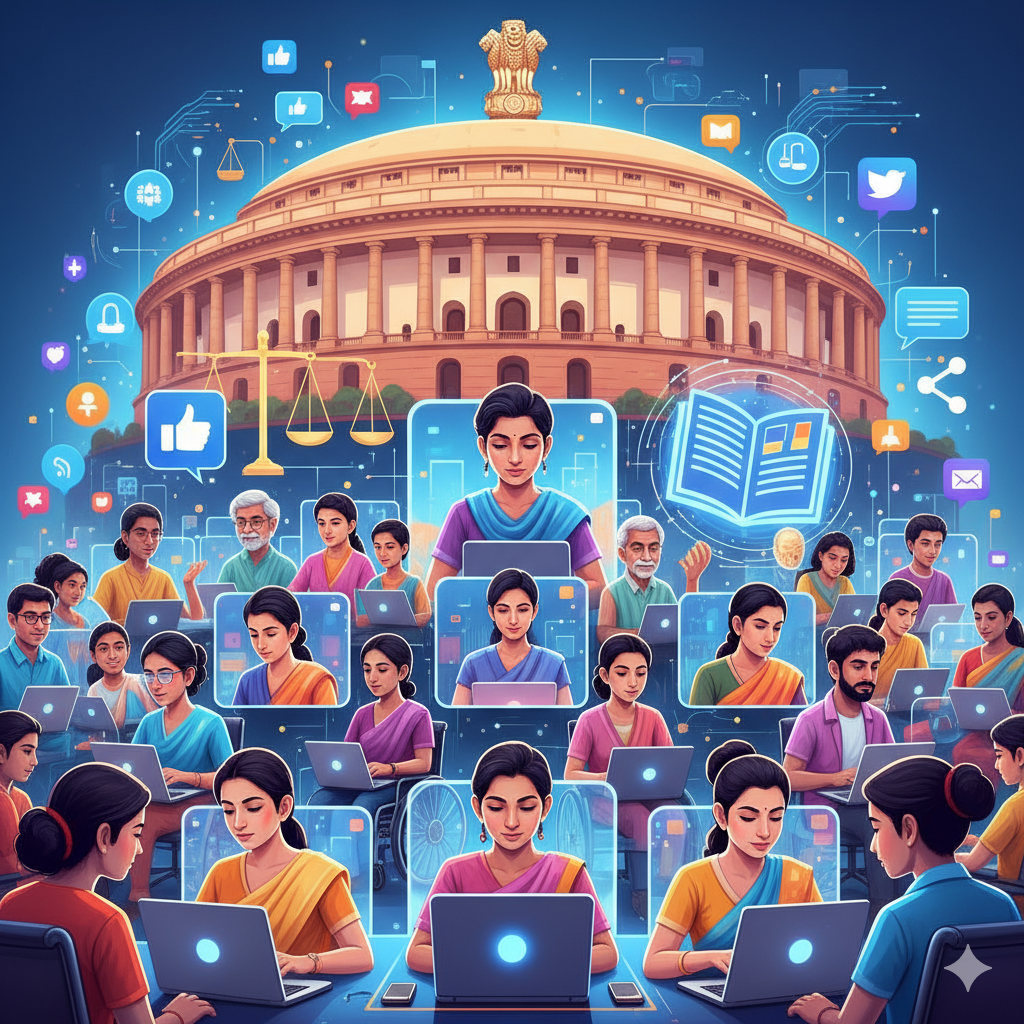

The Ministry of Information and Broadcasting (MIB) should conduct a public consultation on any notification and guidelines it drafts to regulate influencers, Professor VK Tiwari from the West Bengal National University of Juridical Sciences (NUJS) said in his letter to the Ministry. He explained that any social media code would affect the fundamental rights of millions of Indians, adding that an open and multi-stakeholder consultation would allow various sections of the public to participate in the code formation exercise.
Tiwari, an academic with a disability, made the comment in the context of an ongoing court case concerning inappropriate jokes made about persons with disabilities on the YouTube comedy show India’s Got Latent (IGL). On August 25, the Supreme Court issued a directive to the MIB, instructing it to prepare guidelines for social media influencers in consultation with the News Broadcasters and Digital Association (NBDA) and other stakeholders. Besides the social media code, the Supreme Court also asked the comedians who participated in the show to apologize for inappropriate jokes they made about persons with disabilities.
Key points from the letter:
In the August 25 directive, the Supreme Court had noted that social media influencers commercialise free speech. The court mentioned that this gives them the capacity to hurt sentiments, urging the government to include penalties for misconduct in its social media guidelines.
“Commercial speech is protected speech under the Constitution of India. Any framing that treats monetised online expression as a second-class category would be a departure from binding precedent.” Tiwari argued. He also mentioned that prior censorship of content would be unconstitutional. “Prior restraints to posting content online are exceptional and censorship cannot be used to suppress unpopular views, absent a proximate and grave threat to public order,” he said, explaining why such restrictions are unconstitutional.
Tiwari argued that the Indian Constitution limits the grounds for speech restrictions to Article 19(2). For context, Article 19(2) includes reasonable restrictions on free speech in the interest of the sovereignty and integrity of India, the security of the State, friendly relations with Foreign States, public order, decency or morality, or in relation to contempt of court, defamation, or incitement to an offence. Tiwari argued that hurt sentiments cannot be the basis of speech restrictions. He also added that any restrictions the government imposes on free speech should be transparent and follow due process. This includes a notice of actions, access to orders, an opportunity for a hearing, and independent appellate review.
Why it matters:
As MediaNama’s Editor Nikhil Pahwa pointed out in his editorial, incidents like the India’s Got Latent controversy follow a predictable pattern that systematically erodes free speech protections. Each controversy…
Source link
Disclaimer
We strive to uphold the highest ethical standards in all of our reporting and coverage. We blogs.grocliq.com want to be transparent with our readers about any potential conflicts of interest that may arise in our work. It’s possible that some of the investors we feature may have connections to other businesses, including competitors or companies we write about. However, we want to assure our readers that this will not have any impact on the integrity or impartiality of our reporting. We are committed to delivering accurate, unbiased news and information to our audience, and we will continue to uphold our ethics and principles in all of our work. Thank you for your trust and support.
Website Upgradation is going on for any glitch kindly connect at [email protected]