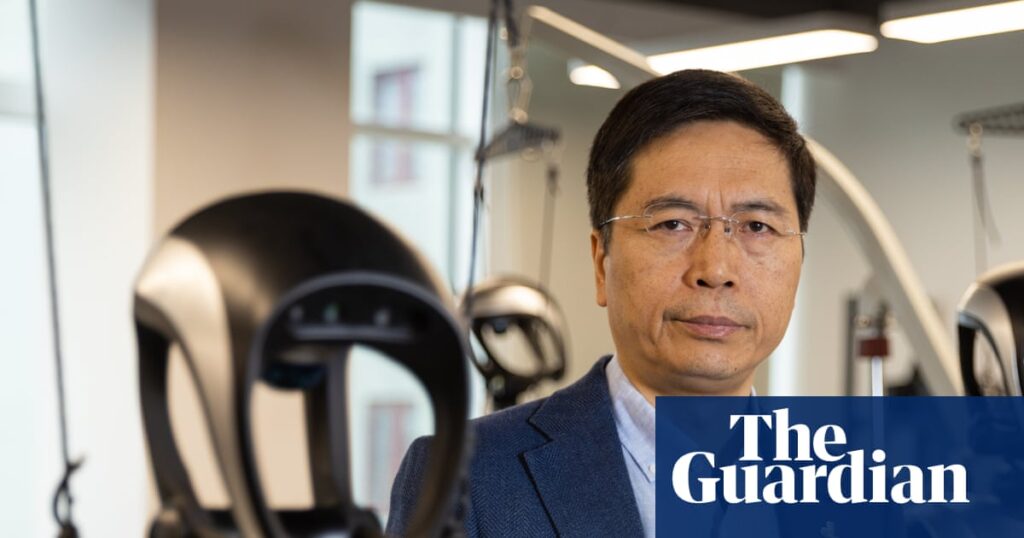

By the time Song-Chun Zhu was six years old, he had encountered death more times than he could count. Or so it felt. This was the early 1970s, the waning years of the Cultural Revolution, and his father ran a village supply store in rural China. There was little to do beyond till the fields and study Mao Zedong at home, and so the shop became a refuge where people could rest, recharge and share tales. Zhu grew up in that shop, absorbing a lifetime’s worth of tragedies: a family friend lost in a car crash, a relative from an untreated illness, stories of suicide or starvation. “That was really tough,” Zhu recalled recently. “People were so poor.”
The young Zhu became obsessed with what people left behind after they died. One day, he came across a book that contained his family genealogy. When he asked the bookkeeper why it included his ancestors’ dates of birth and death but nothing about their lives, the man told him matter of factly that they were peasants, so there was nothing worth recording. The answer terrified Zhu. He resolved that his fate would be different.
Today, at 56, Zhu is one of the world’s leading authorities in artificial intelligence. In 1992, he left China for the US to pursue a PhD in computer science at Harvard. Later, at University of California, Los Angeles (UCLA), he led one of the most prolific AI research centres in the world, won numerous major awards, and attracted prestigious research grants from the Pentagon and the National Science Foundation. He was celebrated for his pioneering research into how machines can spot patterns in data, which helped lay the groundwork for modern AI systems such as ChatGPT and DeepSeek. He and his wife, and their two US-born daughters, lived in a hilltop home on Los Angeles’s Mulholland Drive. He thought he would never leave.
But in August 2020, after 28 years in the US, Zhu astonished his colleagues and friends by suddenly moving back to China, where he took up professorships at two top Beijing universities and a directorship in a state-sponsored AI institute. The Chinese media feted him as a patriot assisting the motherland in its race toward artificial intelligence. US lawmakers would later demand to know how funders such as UCLA and the Pentagon had ignored “concerning signs” of Zhu’s ties to a geopolitical rival. In 2023, Zhu became a member of China’s top political advisory body, where he proposed that China should treat AI with the same strategic urgency as a nuclear weapons programme.
Zhu’s journey from rural China to the helm of one of the US’s leading AI labs was both improbable and part of a much bigger story. For almost a century, the world’s brightest scientific minds were drawn to the US as the place where they could best advance their research. The work of these new arrivals had helped secure US dominance in technologies such as nuclear weapons,…
Source link
Disclaimer
We strive to uphold the highest ethical standards in all of our reporting and coverage. We blogs.grocliq.com want to be transparent with our readers about any potential conflicts of interest that may arise in our work. It’s possible that some of the investors we feature may have connections to other businesses, including competitors or companies we write about. However, we want to assure our readers that this will not have any impact on the integrity or impartiality of our reporting. We are committed to delivering accurate, unbiased news and information to our audience, and we will continue to uphold our ethics and principles in all of our work. Thank you for your trust and support.
Website Upgradation is going on for any glitch kindly connect at [email protected]