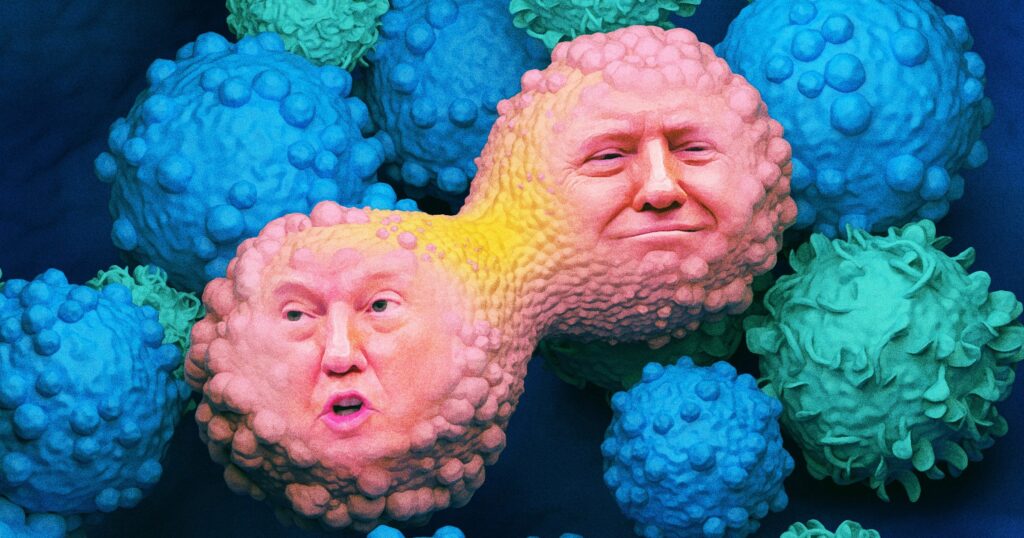

Image by Kevin Dietsch / Clive Brunskill / Getty / Futurism
The United States’ standing as an important place for cancer research is under threat.
As the New York Times reports, the Trump administration has dramatically slashed funding to US-based cancer research, endangering the country’s overall leading position in science research — not to mention the fates of cancer patients across the country.
“We are great in science,” Harold Varmus, former director of the National Institute of Health (NIH) and a Nobel prize-winning scientist, told the NYT. “Why would we want to destroy one of our greatest assets?”
In the first three months of his second term, Trump has slashed $2.7 billion from the NIH’s budget. Federal cancer research, in particular, has seen drastic reductions, which critics say will hamper any advancement in finding effective treatments. This has translated into mass layoffs and the freezing of important ongoing studies.
In addition, Trump has proposed another round of cuts for next year, such as reducing the budget of the NIH agency, the National Cancer Institute, from $7.2 billion to $4.5 billion, according to the NYT.
The cuts could have devastating consequences. According to a study published in the Journal of Clinical Oncology, every $326 spent on cancer research adds a year to one’s life expectancy — a bargain, relatively speaking.
The five-year survival rate for cancer has risen from just 49 percent in the 1970s to 68 percent today, according to the NYT. The implications are enormous — approximately 38.9 percent of Americans are expected to be diagnosed with cancer at some point in their lives, according to the National Cancer Institute.
The push for cuts is animated by distrust among many conservatives that the overall health apparatus in this country has become corrupt, oppressive, and politicized, especially during the worst days of the COVID pandemic when lockdowns were in place. (Tellingly, conservatives also tend to distrust information on cancer from government health organizations.)
Conservatives have also used Diversity, Equity, and Inclusion (DEI) initiatives to justify funding cuts, some of which were flagged erroneously because grant applications contained hot-button words like “trans.”
Vaccine skeptic and secretary of the US Department of Health and Human Services, Robert Kennedy Jr, also canceled promising work on mRNA, which could’ve potentially led to a universal vaccine against cancer, according to experts.
That’s what’s especially galling about these cuts — we know so much more about cancer and are on the brink of some incredible scientific breakthroughs, such as new cancer radiation therapies that are more targeted and less harmful to surrounding healthy tissue, according to the NYT.
“I believe I am one of only a small handful of labs in the country that specializes in drug-delivery barriers in pediatric brain cancer,” University of Massachusetts Chan Medical School professor Rachael Sirianni told the…
Source link
Disclaimer
We strive to uphold the highest ethical standards in all of our reporting and coverage. We blogs.grocliq.com want to be transparent with our readers about any potential conflicts of interest that may arise in our work. It’s possible that some of the investors we feature may have connections to other businesses, including competitors or companies we write about. However, we want to assure our readers that this will not have any impact on the integrity or impartiality of our reporting. We are committed to delivering accurate, unbiased news and information to our audience, and we will continue to uphold our ethics and principles in all of our work. Thank you for your trust and support.
Website Upgradation is going on for any glitch kindly connect at [email protected]