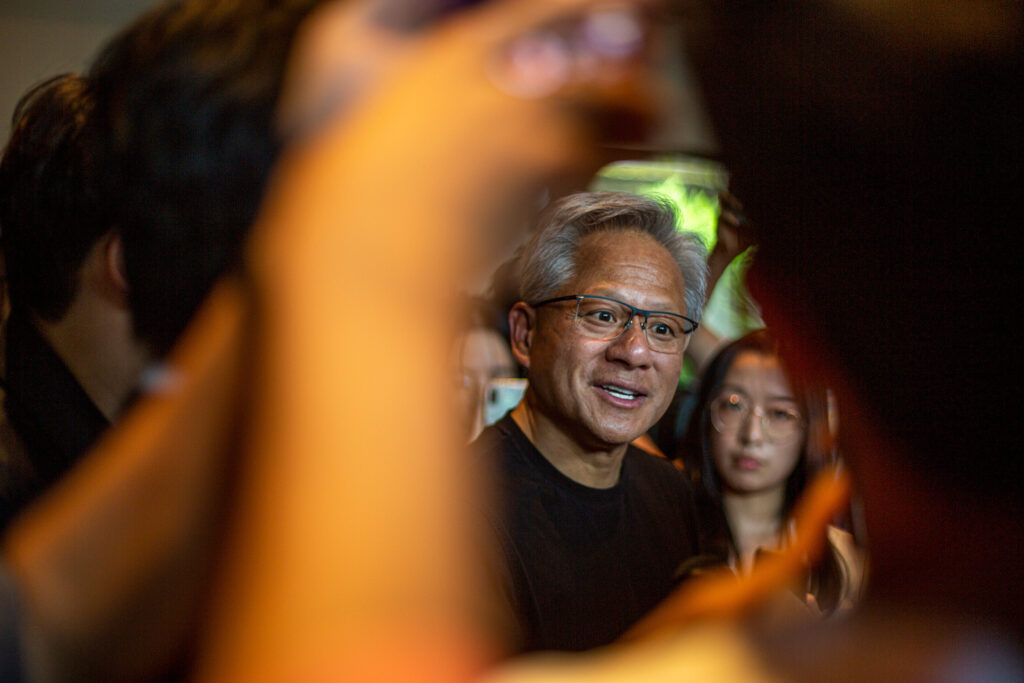

The chip manufacturer Nvidia might be one of the most valuable companies in history for now, but that could change in a heartbeat.
In a recent appearance on the podcast “BG2,” Nvidia CEO Jensen Huang agonized that China is now “nanoseconds behind” US chipmakers, the companies building the hardware undergirding the multi-billion dollar AI boom.
Just weeks ago, China’s internet regulator, the Cyberspace Administration of China (CAC) announced a ban on large Chinese tech firms purchasing Nvidia chips. The ban follows a broader effort by Chinese lawmakers to lessen dependency on foreign companies and promote domestic manufacturing — a similar goal to the worker-led “Keep it Made in America” movement of 2009.
For Huang, the loss of Chinese buyers is a major threat. Not only is Nvidia losing one of its most valuable markets, but it’s also gaining a powerful competitor that threatens its near-monopoly on the global chip trade.
“We’re up against a formidable, innovative, hungry, fast-moving, underregulated [competitor],” Huang stewed. “This is a vibrant, entrepreneurial, high-tech, modern industry.”
“What we need to do as a country,” the CEO continued, “is to enable our technology industry, which today is our national treasure… to go and proliferate the technology around the world. So that we can have the world to be built on top of American technology, so we can maximize our economic success, our geopolitical influence.”
Nvidia isn’t the only Western company trembling about the increasingly independent PRC, but it is a powerful bellwether. In fact, Huang’s lust for economic superiority and geopolitical dominance over China follows over 125 years of US meddling in the country’s affairs.
When it became clear that post-revolutionary China would resist Western colonialization, the US’ response was to exert immense economic pressure on the nation. By 1962, president John F. Kennedy’s foreign policy advisor Walt Rostow was able to brag that a US-led trade embargo was devastating the PRC, delaying its economic development for at least “tens of years.”
Now the chickens have come home to roost. For decades, China has been running an experiment to allow limited foreign investment into the country, a strategy known as “reform and opening up.” Throughout this process, China’s political leadership maintained strict regulations over the rights of foreign companies, leveraging the country’s vast workforce to avoid the economic disasters which came to define similar projects in Russia and the former Yugoslavia.
While an entire generation in China was subjected to horrifying work conditions typical of other nations exploited by international corporations, the People’s Republic in turn gained access to the cutting-edge technologies of the West. It has since used those resources to develop an increasingly independent…
Source link
Disclaimer
We strive to uphold the highest ethical standards in all of our reporting and coverage. We blogs.grocliq.com want to be transparent with our readers about any potential conflicts of interest that may arise in our work. It’s possible that some of the investors we feature may have connections to other businesses, including competitors or companies we write about. However, we want to assure our readers that this will not have any impact on the integrity or impartiality of our reporting. We are committed to delivering accurate, unbiased news and information to our audience, and we will continue to uphold our ethics and principles in all of our work. Thank you for your trust and support.
Website Upgradation is going on for any glitch kindly connect at [email protected]