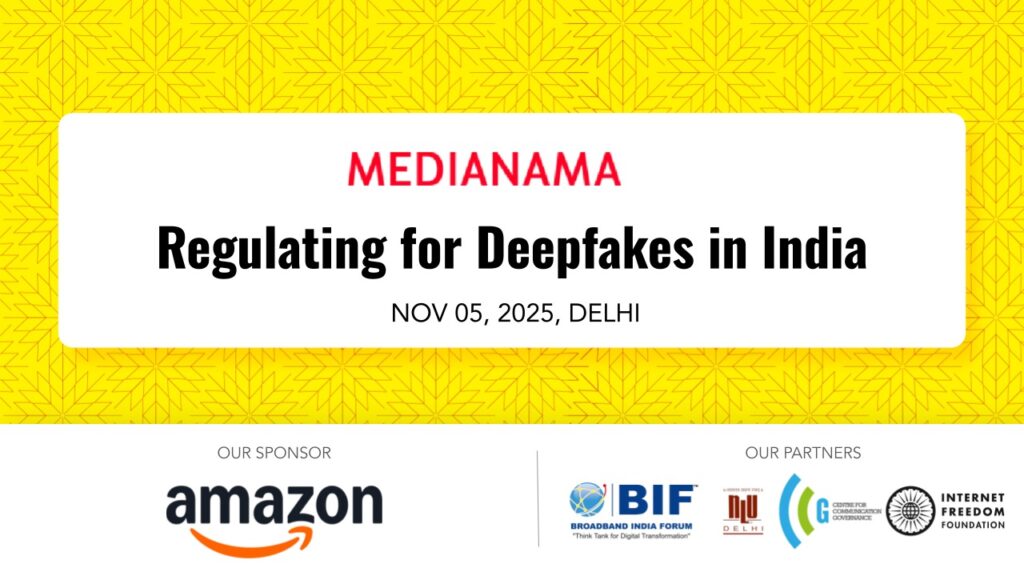

Visible labelling requirements under the draft amendment to the Information Technology (Intermediary Guidelines and Digital Media Ethics Code) Rules, 2021 may affect how advertisements are produced, distributed, and perceived online, speakers at MediaNama’s panel discussion “Regulating for Deepfakes in India” pointed out on November 5.
“If an ad starts to be said it’s made by AI, I see the latter being the case right now because of lack of awareness on why it is being done to put out a logo that if you say, ‘Hey, this ad is made by AI,’ the chances are people are just going to pull back from it and may not click. This may have up to 15% of business impact when people who are trying to run an ad and spend money,” said Siddharth Puri, Founder and CEO of Tyroo.
The amendment seeks to legally define synthetically generated media, require visible labelling and persistent metadata, mandate user declarations verified by Significant Social Media Intermediaries (SSMIs), and expand due diligence obligations for platforms that host or distribute synthetic media.
[Note: This reporting reflects Session 1 (“Impact of the Regulation on Businesses and Technical Challenges for Implementation”), where speakers waived the Chatham House Rule. Under the Chatham House Rule, participants’ remarks may be reported, but their names and affiliations cannot be disclosed.]How advertisers are currently using AI?
Puri explained that AI has increased the supply of digital media and allowed advertisers to target users more precisely.
“Advertising follows wherever the eyeballs are. The biggest problem statement in advertising has always been, are we showing the right ad to the right customer? Are you getting to see what is relevant for you? Relevance is the Holy Grail of advertising,” Puri said.
He added that AI-based content generation has enabled smaller advertisers to run campaigns in formats that were previously cost-prohibitive.
“Now you’re able to create a well-produced video ad, allowing even smaller businesses to go to television and Over-the-top (OTT) platforms as advertisers much faster. It’s really democratised the opportunity for many media owners who did not have that chance,” he noted.
Puri also said that the number of meaningful advertisers spending online has expanded sharply over the past five years:
“Before COVID, we would typically see around 25,000 people advertising. Now, at $11 billion, our AdX has expanded to 140,000 such brands,” he said.
What happens when a visible label is added to ads?
Puri shared results from Tyroo’s A/B experiments, adding a brand marker occupying about 10% of an ad’s visual area.
“For the person who was a brand retailer, it had a positive enforcement. As soon as the brand logo came on the video ad, occupying 10% of the space, we saw an uplift of approximately 10–12% because it added trust,” Puri said.
However, the same treatment…
Source link
Disclaimer
We strive to uphold the highest ethical standards in all of our reporting and coverage. We blogs.grocliq.com want to be transparent with our readers about any potential conflicts of interest that may arise in our work. It’s possible that some of the investors we feature may have connections to other businesses, including competitors or companies we write about. However, we want to assure our readers that this will not have any impact on the integrity or impartiality of our reporting. We are committed to delivering accurate, unbiased news and information to our audience, and we will continue to uphold our ethics and principles in all of our work. Thank you for your trust and support.
Website Upgradation is going on for any glitch kindly connect at [email protected]