

Picture a chocolate company with an elaborate recipe, generations old. They ask an AI system to identify which ingredients they could remove to cut costs. The AI suggests one. They remove it. Sales hold steady. They ask again. The AI suggests another. This continues through four or five iterations until they’ve created the cheapest possible version of their product. Fantastic margins, terrible sales. When someone finally tastes it, the verdict is immediate: “This isn’t even chocolate anymore.”
Aly Blawat, senior director of customer strategy at Blain’s Farm & Fleet, shared this story during a recent MarTech webinar to illustrate why 82% of marketing teams are failing at AI adoption: automation without human judgment doesn’t just fail. It compounds failure faster than ever before. And that failure has nothing to do with the technology itself.
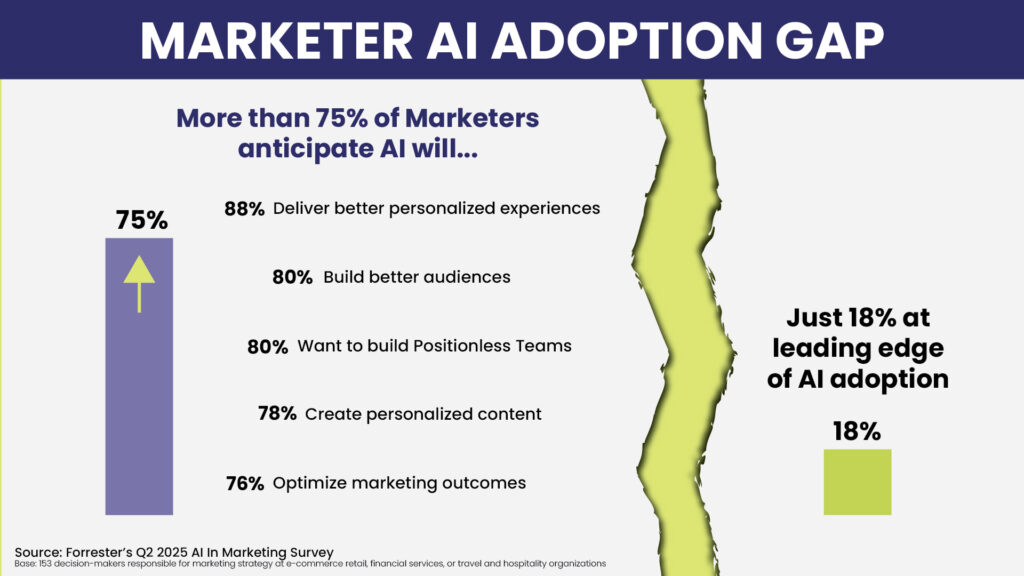
The numbers tell the story. In a Forrester study commissioned by Optimove, only 18% of marketers consider themselves at the leading edge of AI adoption, even though nearly 80% expect AI to improve targeting, personalization and optimization. Forrester’s Rusty Warner, VP and principal analyst, puts this in context: only about 25% of marketers worldwide are in production with any AI use cases. Another third are experimenting but haven’t moved to production. That leaves more than 40% still learning about what AI might do for them.
“This particular statistic didn’t really surprise me,” Warner said. “We find that a lot of people that are able to use AI tools at work might be experimenting with them at home, but at work, they’re really waiting for their software vendors to make tools available that have been deemed safe to use and responsible.”
The caution is widespread. IT teams have controls in place for third-party AI tools. Even tech-savvy marketers who experiment at home often can’t access those tools at work until vendors embed responsible AI, data protections and auditability directly into their platforms.
The problem isn’t the AI tools available today. It’s that marketing work is still structured the same way it was before AI existed.
The individual vs. the organization
Individual marketers are thirsty for AI tools. They see the potential immediately. But organizations are fundamentally built for something different: control over brand voice, short-term optimization and manual processes where work passes from insights teams to creative teams to activation teams, each handoff adding days or weeks to cycle time.
Most marketing organizations still operate like an assembly line. Insights come from one door, creative from another, activation from a third. Warner called this out plainly: “Marketing still runs like an assembly line. AI and automation break that model, letting marketers go beyond their position to do more and be more agile.”
The assembly line model is excellent at governance and terrible at speed. By the time results return,…
Source link
Disclaimer
We strive to uphold the highest ethical standards in all of our reporting and coverage. We blogs.grocliq.com want to be transparent with our readers about any potential conflicts of interest that may arise in our work. It’s possible that some of the investors we feature may have connections to other businesses, including competitors or companies we write about. However, we want to assure our readers that this will not have any impact on the integrity or impartiality of our reporting. We are committed to delivering accurate, unbiased news and information to our audience, and we will continue to uphold our ethics and principles in all of our work. Thank you for your trust and support.
Website Upgradation is going on for any glitch kindly connect at [email protected]