

Boost your skills with Growth Memo’s weekly expert insights. Subscribe for free!
AI search visibility isn’t “too risky” to invest in for executives to buy-in. Selling AI search strategies to leadership is about risk.
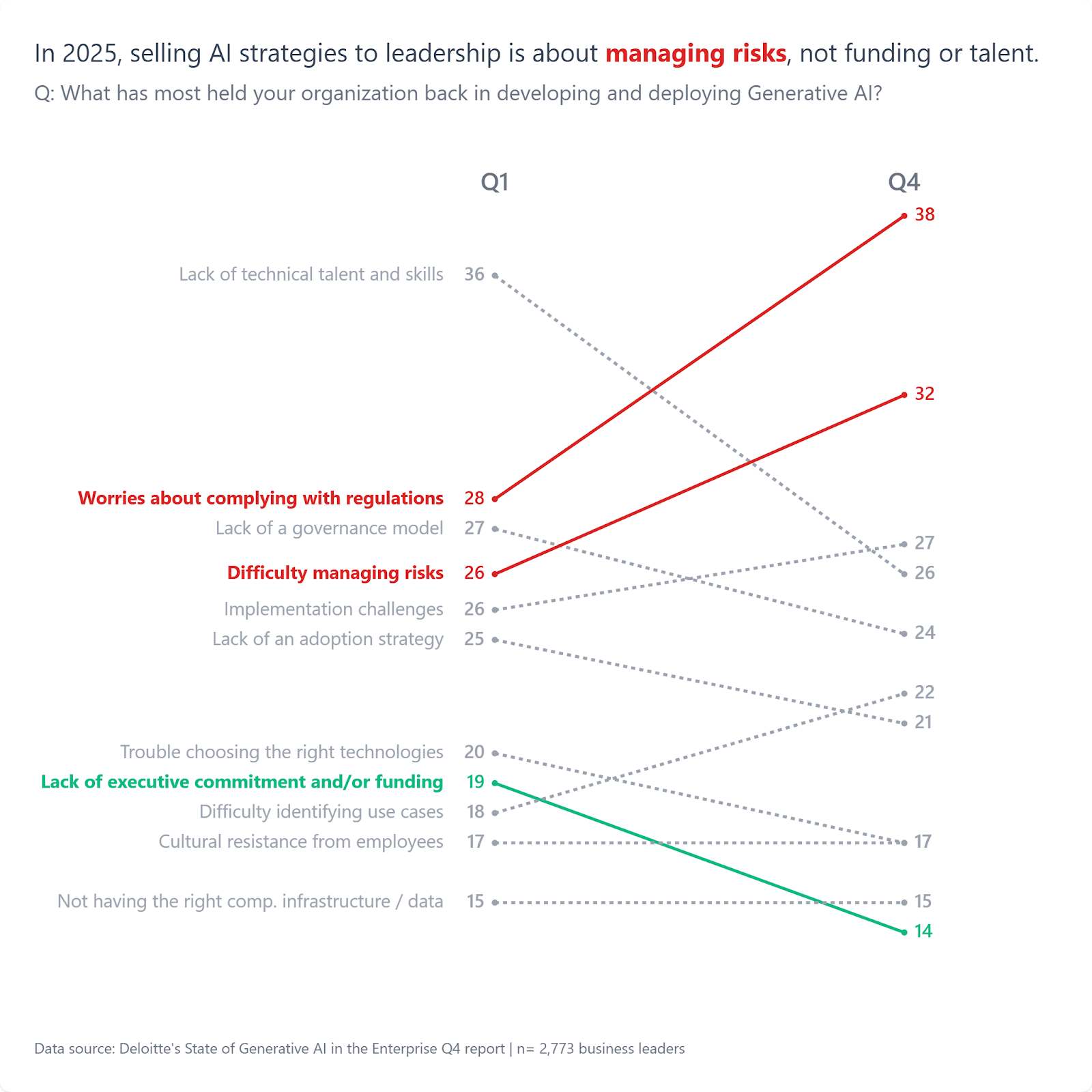 Image Credit: Kevin Indig
A Deloitte survey of +2,700 leaders reveals that getting buy-in for an AI search strategy isn’t about innovation, but risk.
SEO teams keep failing to sell AI search strategies for one reason: They’re pitching deterministic ROI in a probabilistic environment.
The old way: Rankings → traffic → revenue. But that event chain doesn’t exist in AI systems.
LLMs don’t rank. They synthesize. And Google’s AI Overviews and AI Mode don’t “send traffic.” They answer.
Yet most teams still walk into a leadership meeting with a deck built on a decaying model. Then, executives say no – not because AI search “doesn’t work,” but because the pitch asks them to fund an outcome nobody can guarantee.
In AI search, you cannot sell certainty. You can only sell controlled learning.
1. You Can’t Sell AI Search With A Deterministic ROI Model
Everyone keeps asking the wrong question: “How do I prove my AI search strategy will work so leadership will fund it?” You can’t; there’s no traffic chain you can model. Randomness is baked directly into the outputs.
You’re forcing leadership to evaluate your AI search strategy with a framework that’s already decaying. Confusion about AI search vs. traditional SEO metrics and forecasting is blocking you from buy-in. When SEO teams try to sell an AI search strategy to leadership, they often encounter several structural problems:
- Lack of clear attribution and ROI: Where you see opportunity, leadership sees vague outcomes and deprioritizes investment. Traffic and conversions from AI Overviews, ChatGPT, or Perplexity are hard to track.
- Misalignment with core business metrics: It’s harder to tie results to revenue, CAC, or pipeline – especially in B2B.
- AI search feels too experimental: Early investments feel like bets, not strategy. Leadership may see this as a distraction from “real” SEO or growth work.
- No owned surfaces to leverage: Many brands aren’t mentioned in AI answers at all. SEO teams are selling a strategy that has no current baseline.
- Confusion between SEO and AI search strategy: Leadership doesn’t understand the distinction between optimizing for classic Google Search vs. LLMs vs. AI Overviews. Clear differentiation is needed to secure a new budget and attention.
- Lack of content or technical readiness: The site lacks the structured content, brand authority, or documentation to appear in AI-generated results.
2. Pitch AI Search Strategy As Risk Mitigation, Not Opportunity
Executives don’t buy performance in ambiguous environments. They buy decision quality. And the decision they need you to make is simple: Should your brand invest in AI-driven discovery before competitors lock in the advantage – or not?
 Image…
Source link
Disclaimer
We strive to uphold the highest ethical standards in all of our reporting and coverage. We blogs.grocliq.com want to be transparent with our readers about any potential conflicts of interest that may arise in our work. It’s possible that some of the investors we feature may have connections to other businesses, including competitors or companies we write about. However, we want to assure our readers that this will not have any impact on the integrity or impartiality of our reporting. We are committed to delivering accurate, unbiased news and information to our audience, and we will continue to uphold our ethics and principles in all of our work. Thank you for your trust and support.
Website Upgradation is going on for any glitch kindly connect at [email protected]