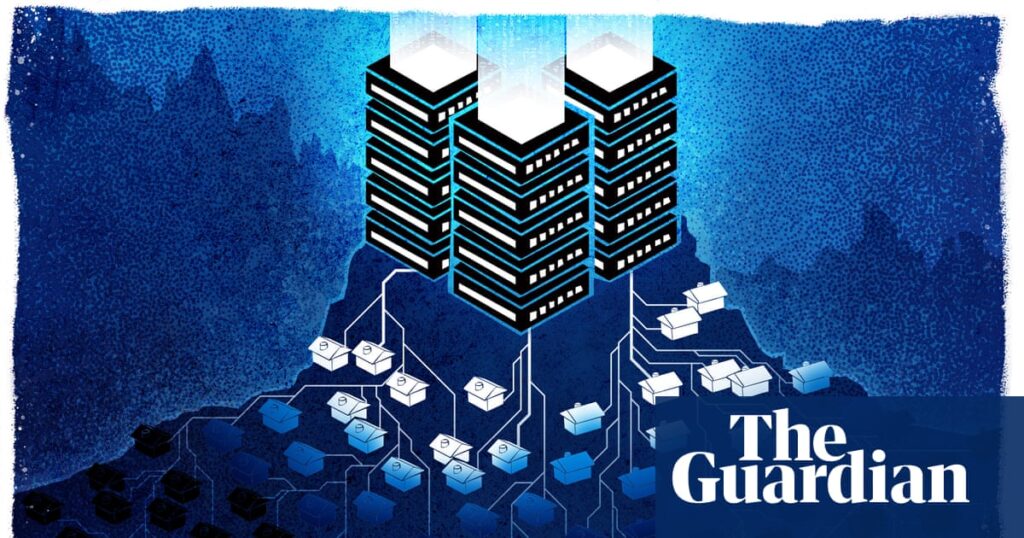

Datacentre power demand in Australia could triple in five years and is forecast to exceed by 2030 the energy used by electric vehicles.
Datacentres now draw about 2% of electricity from the National Grid, about 4 terawatt hours of power. The Australian Energy Market Operator (Aemo) expects that share to rise rapidly – growing 25% year-on-year – to reach 12TWh, or 6% of grid demand, by 2030, and 12% by 2050.
Rapid growth of the industry will drive “substantial increases in electricity consumption, for Sydney and Melbourne, in particular”, Aemo forecasts.
In New South Wales and Victoria, where most are located, datacentres could comprise 11% and 8% of each state’s electricity demand, respectively, by 2030.
Technology companies including OpenAI and SunCable are pushing for Australia to become a hub for data processing and storage. Last month the Victorian state government announced a “$5.5m investment to become Australia’s datacentre capital”.
But with 260 centres operating nationally, and dozens more in the offing, experts are flagging concerns about what the industry’s unfettered growth could mean for the energy transition and climate targets.
Energy use equivalent to 100,000 households
Banks of servers running 24/7 in a confined space generate massive amounts of heat and require electricity to run and cool them.
Sign up to get climate and environment editor Adam Morton’s Clear Air column as a free newsletter
Datacentre demand globally is growing four times faster than all other sectors, according to the International Energy Agency. Centres are multiplying and are increasing in size, with hyperscale facilities becoming more common.
According to the IEA: “A hyperscale, AI-focused datacentre can have a capacity of 100MW or more, consuming as much electricity annually as 100,000 households.”
The consumption of electricity and water is largely related to cooling, as servers, like other computing devices, convert electrical energy into heat, according to Prof Michael Brear, a professor of mechanical engineering and director of the Net Zero Australia project at the University of Melbourne.
“When you have a very large number of computers in a confined space, you need to air condition the space to maintain these devices at a safe and efficient working temperature,” he says.
Most digital infrastructure is cooled using air conditioning or water.
Ketan Joshi, an Oslo-based climate analyst associated with the Australia Institute, says many technology companies are now reporting accelerating power consumption year-on-year. The intensity of energy use is also rising against multiple metrics – energy per active user, per unit of revenue – compared with five years ago, he says.
“They’re not using more energy to serve more people or to make more money,” he says. “The question that everybody should be asking is why are you consuming more energy?”
In the absence of concrete data, Joshi says the most reasonable assumption is that the…
Source link
Disclaimer
We strive to uphold the highest ethical standards in all of our reporting and coverage. We blogs.grocliq.com want to be transparent with our readers about any potential conflicts of interest that may arise in our work. It’s possible that some of the investors we feature may have connections to other businesses, including competitors or companies we write about. However, we want to assure our readers that this will not have any impact on the integrity or impartiality of our reporting. We are committed to delivering accurate, unbiased news and information to our audience, and we will continue to uphold our ethics and principles in all of our work. Thank you for your trust and support.
Website Upgradation is going on for any glitch kindly connect at [email protected]