
Major SEO platforms, such as Ahrefs and Semrush, along with agencies like Seer Interactive and other leading companies, have released substantial studies that appear to offer definitive answers.
But a closer look reveals something else entirely: nearly every possible narrative about AI search impact has a “study” to support it.
The more I examined the data, the clearer a more uncomfortable truth became – no one has the definitive answer, and the numbers can be sliced to validate almost any storyline.
The core consensus that isn’t really consensus
At first glance, the major studies agree on fundamentals.
Ahrefs reports that top-ranking organic results lose approximately 34-34.5% of clicks when AI Overviews appear. Their analysis of 300,000 keywords presents this as a clear, quantifiable impact.
They reference research showing an almost 100% zero-click rate in Google’s AI Mode, suggesting that AI search poses a fundamental threat to website traffic.

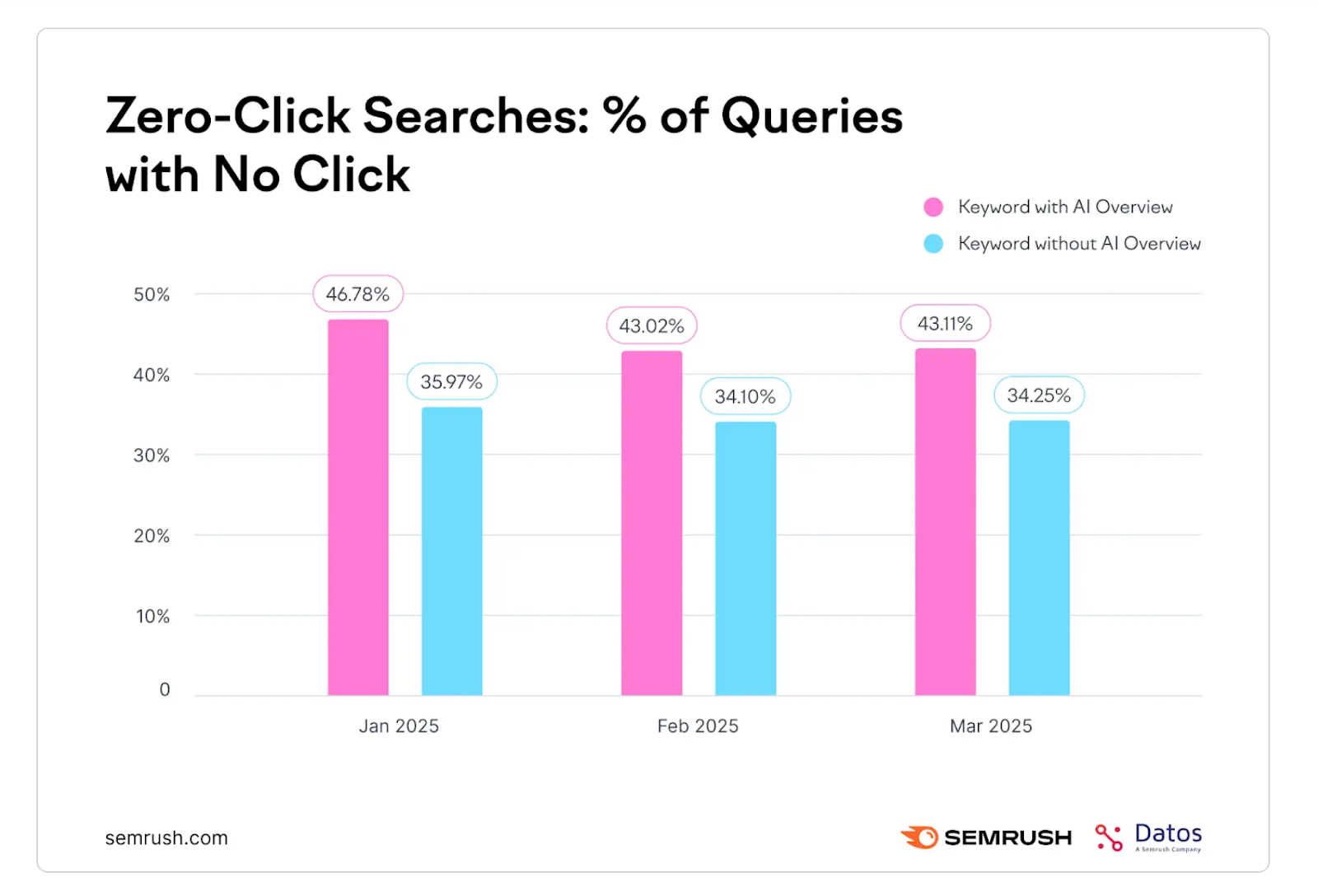
Yet Semrush, analyzing over 10 million keywords, found something different: a slight decrease in zero-click searches after AI Overviews were introduced.
This directly contradicts the narrative of AI features inevitably increasing zero-click behavior.
Instead of crisis, Semrush emphasizes opportunity, claiming that AI search visitors are 4.4 times more valuable than traditional organic visitors.
Neither can be entirely right, yet both are presented with statistical authority.
The conversion rate debate: 5 studies, 5 different answers
The confusion becomes even more pronounced when examining how AI search traffic converts compared to traditional Google organic traffic.
Here, the research becomes almost funny in its contradictions.
- Amsive’s research, analyzing hundreds of client websites, concluded that ChatGPT converts at a higher rate than Google. This “difference” finding suggests AI search educates users with top-of-the-funnel content before converting, and has higher commercial value.

- A study by Kaise and Schulze examining more than 973 ecommerce websites – covered by Search Engine Land – reached the opposite conclusion. ChatGPT converts worse than Google. For ecommerce businesses in particular, this research suggests AI search traffic is lower quality and less likely to generate revenue.

- Ahrefs examined its own conversion data and determined that ChatGPT converts better than Google. This aligns with their broader narrative that while AI search may reduce traffic volume, it increases traffic quality.
- Seer Interactive analyzed data from several client websites and also concluded that ChatGPT converts better than Google, supporting the “quality over quantity” interpretation.
- Peep Laja, founder of Wynter, reviewed his company’s conversion data and drew yet another conclusion: LLMs are sending “lazy, unqualified traffic” that converts poorly. His real-world business experience contradicts…
Source link
Disclaimer
We strive to uphold the highest ethical standards in all of our reporting and coverage. We blogs.grocliq.com want to be transparent with our readers about any potential conflicts of interest that may arise in our work. It’s possible that some of the investors we feature may have connections to other businesses, including competitors or companies we write about. However, we want to assure our readers that this will not have any impact on the integrity or impartiality of our reporting. We are committed to delivering accurate, unbiased news and information to our audience, and we will continue to uphold our ethics and principles in all of our work. Thank you for your trust and support.
Website Upgradation is going on for any glitch kindly connect at [email protected]