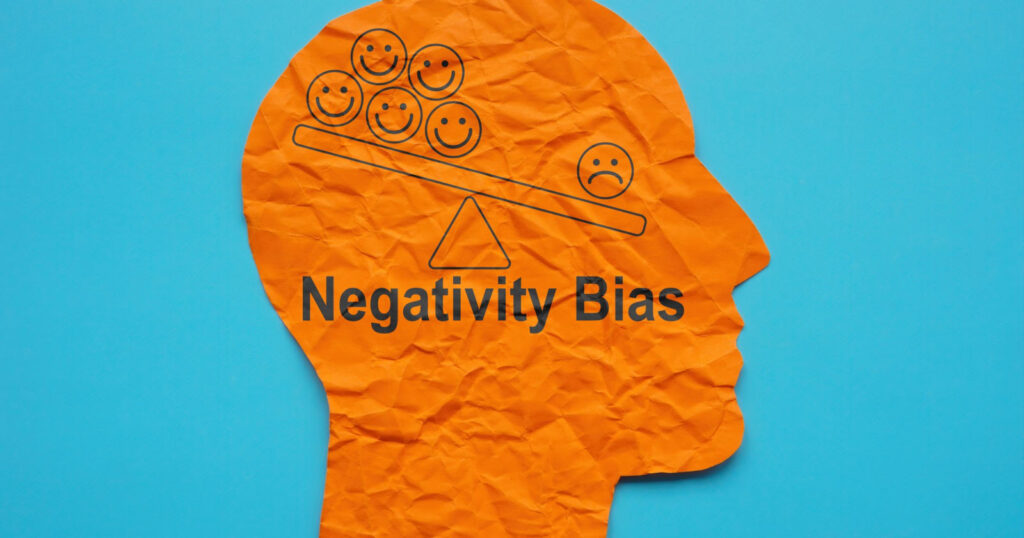

Picture this: You’re sitting on a train to see a friend of yours you haven’t seen in a long time, sipping your favorite coffee order, and looking at a beautiful landscape outside the window. Everything is going great. Right up until someone sits right next to you, chatting loudly on the phone and ruining that peaceful journey of yours. Even though the train gets to its destination on time and without a hiccup, do you think you are most likely to mention the coffee, the landscape, and the quiet of the first part of the journey, or that annoying seatmate, when you friend asks how the journey’s been?
If you chose the latter, it’s not because you are a particularly pessimistic person. It’s all very normal, part of a common phenomenon known as negativity bias.
What Is The Negativity Bias?
The negativity bias is defined as an overattention to the negative aspects of an experience as compared to positive ones that carry the same emotional load. It affects the way we process and remember information, but also the way we interpret the world around us and make decisions. In short, it makes us value and remember the “bad” much more than the “good.”
The origins of the negativity bias are still under debate, and different theories have been raised, but one thing seems clear: It’s so ingrained in our biological profile that it even shows up as a functional asymmetry in our brain. That means that certain regions involved in emotional processing (like the amygdala and the pregenual anterior cingulate cortex) tend to process negative stimuli faster, or respond to them in a stronger way, showing that a greater weight is assigned to averse stimuli and situations as compared to neutral and positive ones. This has been corroborated by electroencephalography (EEG) studies isolating larger late positive potential amplitudes, which are a measure of stimulus significance, for negative rather than positive stimuli.
These neurobiological markers translate in a negative overattention that can be seen at the behavioral level from a very early age, which tends to rule out the possibility of the bias as a learned behavior. According to evolutionary theories, the bias might be tied to an early and adaptive response to threat, which hardwired us to be wary of negative or ambiguous stimuli in order to safeguard our species’ survival.
The Negativity Bias In Marketing
Given the power of negativity in shaping the perception of the world and, most importantly, our impressions and judgements, it is only natural that our industry has learned to leverage this bias as a way to get more content traction online. Think about those TikTok videos that start with a deceptive hook along the lines of “Why I’ll never buy [brand]” to then list only positive aspects of the experience. Or the way clickbait headlines still work, despite the fact we know exactly what the media are doing.
Several marketing studies have shown that CTRs are higher across different channels…
Source link
Disclaimer
We strive to uphold the highest ethical standards in all of our reporting and coverage. We blogs.grocliq.com want to be transparent with our readers about any potential conflicts of interest that may arise in our work. It’s possible that some of the investors we feature may have connections to other businesses, including competitors or companies we write about. However, we want to assure our readers that this will not have any impact on the integrity or impartiality of our reporting. We are committed to delivering accurate, unbiased news and information to our audience, and we will continue to uphold our ethics and principles in all of our work. Thank you for your trust and support.
Website Upgradation is going on for any glitch kindly connect at [email protected]