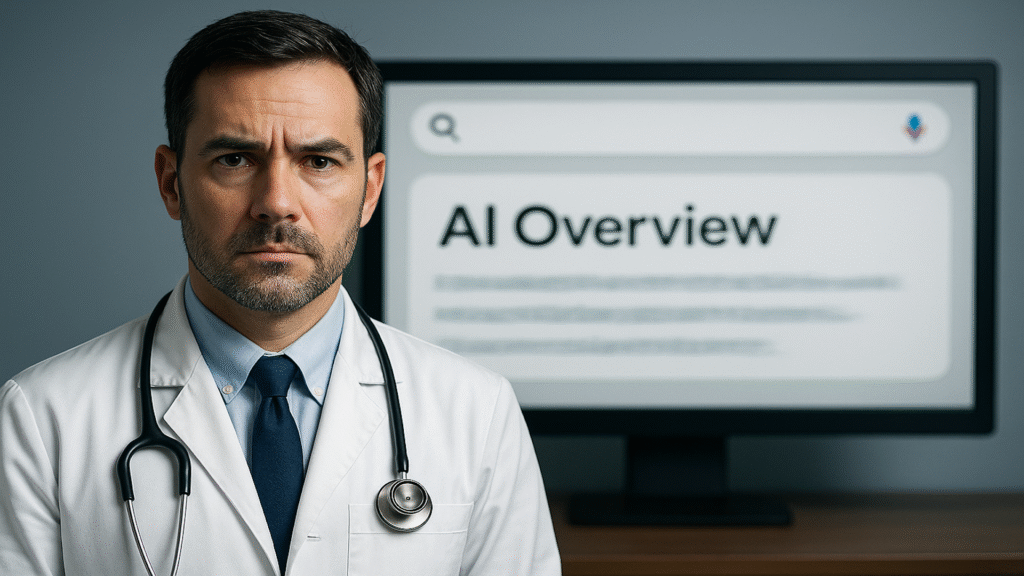

UK doctor and YouTuber Dr. Ed Hope said Google’s AI falsely claimed he was suspended by the General Medical Council earlier this year for selling sick notes. Hope called the allegation completely made up and warned that it could seriously damage his career.
Google’s AI generated a detailed narrative accusing Hope of professional misconduct, despite no investigations, complaints, or sanctions in his 10-year medical career, he said in a new video.
Why we care. Google’s AI-generated answers appear to now be presenting false, career-damaging claims about real people as fact. That raises serious questions about defamation, accountability, and whether AI-generated statements fall outside Section 230 protections.
What Google’s AI said: Hope shared screenshots of Google’s AI stating that he:
- Was suspended by the medical council in mid-2025.
- Profited from selling sick notes.
- Exploited patients for personal gain.
- Faced professional discipline following online fame.
‘None of this is true.’ Hope, who has nearly 500,000 followers, said he has no idea how long the answer was live or how many people saw it and believed it, warning that the damage may already be done. After discovering the AI Overview, he replicated the hallucination and found more false claims, including accusations that he misled insurers and stole content.
- “This is just about the most serious allegation you can get as a doctor. You basically aren’t fit to practice medicine,” he said.
How did this happen? Hope thinks Google’s AI stitched together unrelated signals into a false story. The AI conflated identities and events, then presented the result as factual history, he said:
- He hadn’t posted on YouTube in months
- His channel is called “Sick Notes”
- Another doctor, Dr. Asif Munaf, was involved in a real sick-note scandal
Why this is more from “just a mistake.” The AI didn’t hedge, speculate, or ask questions, Hope said. It asserted false claims as settled fact. Hope said that matters because:
- AI answers are framed as authoritative.
- Users can’t see sources, bias, or motivation.
- There’s no clear path for correction or accountability.
- The claims targeted a private individual, not a public controversy.
The big legal question. Is Google’s AI committing defamation? Or is Google protected by Section 230, which typically shields platforms from liability for third-party content? Courts may ultimately decide. For now, some legal experts have argued that:
- AI-generated outputs are not third-party speech
- The model is creating and publishing new statements
- False claims presented as fact may qualify as defamation
Resolved? Searching for [what happened to dr. ed hope sick notes] showed this Google AI Overview:
Dr. Ed Hope (of the “Dr. Hope’s Sick Notes” YouTube channel) faced scrutiny and suspension by the medical counsil in mid-2025 for his involvement with a…
Source link
Disclaimer
We strive to uphold the highest ethical standards in all of our reporting and coverage. We blogs.grocliq.com want to be transparent with our readers about any potential conflicts of interest that may arise in our work. It’s possible that some of the investors we feature may have connections to other businesses, including competitors or companies we write about. However, we want to assure our readers that this will not have any impact on the integrity or impartiality of our reporting. We are committed to delivering accurate, unbiased news and information to our audience, and we will continue to uphold our ethics and principles in all of our work. Thank you for your trust and support.
Website Upgradation is going on for any glitch kindly connect at [email protected]