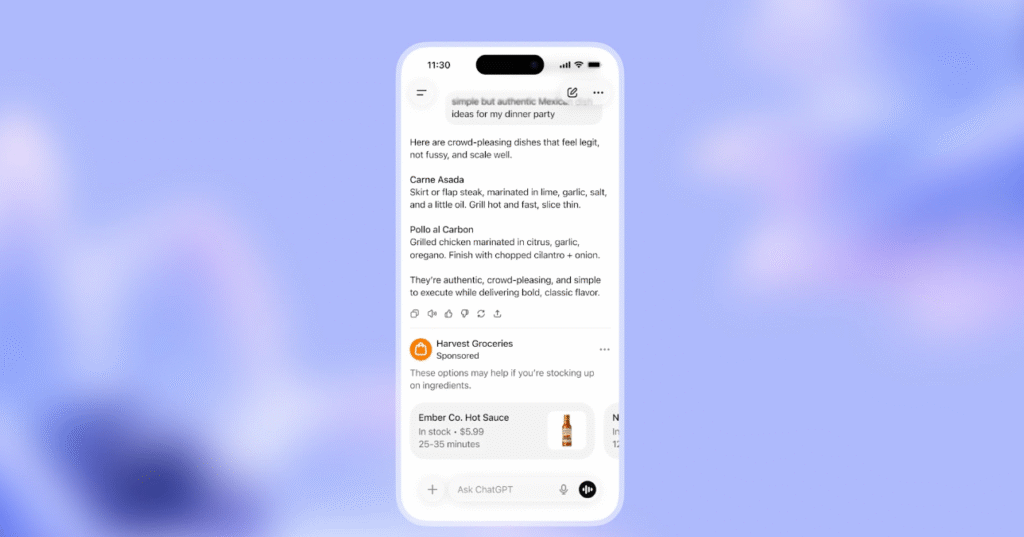

Just today, OpenAI confirmed it will begin testing advertising in the United States for ChatGPT Free and ChatGPT Go users in the coming weeks, marking the first time ads will appear inside the ChatGPT experience.
The test coincides with the U.S. launch of ChatGPT Go, a low-cost subscription tier priced at $8 per month that has been available internationally since August.
The details reveal a cautious approach, with clear limits on where ads can appear, who will see them, and how they will be separated from ChatGPT’s responses.
Here’s what OpenAI shared, how the tests will work, and why this shift matters for users and advertisers alike.
What OpenAI Is Testing
ChatGPT ads are not being introduced as part of a broader redesign or monetization overhaul. Instead, OpenAI is framing this as a limited test, with narrow placement rules and clear separation from ChatGPT’s core function.
Ads will appear at the bottom of a response, only when there is a relevant sponsored product or service tied to the active conversation. They will be clearly labeled, visually distinct from organic answers, and dismissible.
Users will also be able to see why a particular ad is being shown and turn off ad personalization entirely if they choose.
Just as important is where ads will not appear.
OpenAI stated that ads will not be shown to users under 18 and will not be eligible to run near sensitive or regulated topics, including health, mental health, and politics. Conversations will not be shared with advertisers, and user data will not be sold.
Timing Ad Testing with the Go Tier Launch
The timing of the announcement doesn’t seem accidental.
Alongside the ad testing plans, OpenAI confirmed that ChatGPT Go is now available in the United States.
Priced at $8 per month, Go sits between the free tier and higher-cost subscriptions, offering expanded access to messaging, image generation, file uploads, and memory.
Ads are positioned as a way to support both the free tier and Go users, allowing more people to use ChatGPT with fewer restrictions without forcing an upgrade.
At the same time, OpenAI made it clear that Pro, Business, and Enterprise subscriptions will remain ad-free, reinforcing that paid tiers are still the preferred path for users who want an uninterrupted experience.
Explaining the Guardrails of Early Ad Testing
OpenAI spent as much time explaining what ads will not do as what they will.
The company was explicit that advertising will not influence ChatGPT’s responses. Answers are optimized for usefulness, not commercial outcomes. There is no intent to optimize for time spent, engagement loops, or other metrics commonly associated with ad-driven platforms.
This is a notable departure from how advertising has historically been introduced elsewhere on the internet. Rather than retrofitting ads into an existing product and adjusting incentives later, OpenAI is attempting to define the rules up front.
Whether those rules hold over time is an open question….
Source link
Disclaimer
We strive to uphold the highest ethical standards in all of our reporting and coverage. We blogs.grocliq.com want to be transparent with our readers about any potential conflicts of interest that may arise in our work. It’s possible that some of the investors we feature may have connections to other businesses, including competitors or companies we write about. However, we want to assure our readers that this will not have any impact on the integrity or impartiality of our reporting. We are committed to delivering accurate, unbiased news and information to our audience, and we will continue to uphold our ethics and principles in all of our work. Thank you for your trust and support.
Website Upgradation is going on for any glitch kindly connect at [email protected]