
Over the last 12-18 months, the rhetoric across Search Engine Land has shifted.
There’s now broad agreement that people don’t just “Google” to discover brands anymore.
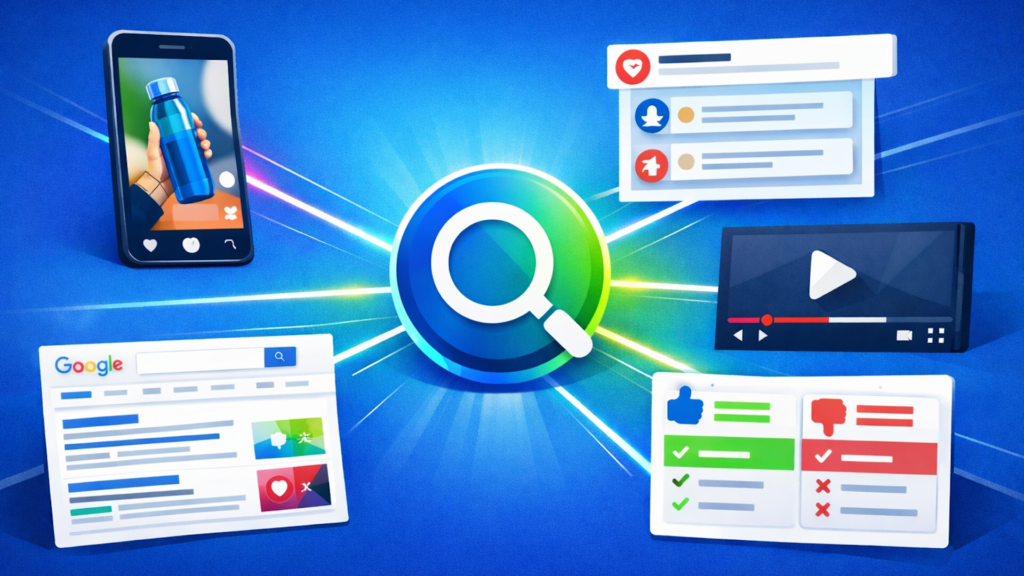
Audiences are finding brands on TikTok, researching on Reddit, watching YouTube, and increasingly asking AI to summarize everything for them – determining whether a brand is found or ignored.
Discoverability is no longer about ranking first on a single platform.
It’s about showing up consistently across the touchpoints that make up your audience’s search universe, wherever decisions are actually being made.
In this new landscape, two tactics are quietly doing much of the heavy lifting: digital PR and social search.
Not as separate disciplines, but as a combined system for building authority, visibility, and recall across traditional search, social platforms, and AI-powered answers.
- Digital PR creates credibility at scale, giving brands authority and trustworthiness.
- Social search ensures distribution, making that credibility visible, repeatable, and memorable and, when done well, anchoring brands in culture and real-world conversation.
Together, they do more than shape preference. They form one of the most effective approaches to discoverability heading into 2026.
This is not a future prediction or a trend piece.
Brands already winning attention today are not choosing between links and social search.
They are designing campaigns where earned authority fuels searchable, platform-native content that travels wherever audiences – and algorithms – look.
Search is no longer the destination, it’s a layer
For years, search was treated as a place – a “Google”-shaped box where intent was captured and answers were delivered.
You optimized for it, ranked in it, and measured success by how high you appeared.
That model no longer holds. Search now sits on top of behavior, not at the center of it.
It’s embedded across platforms, formats, and experiences. People don’t stop what they are doing to “go and search.”
Search often starts passively and becomes more active as intent builds. Ultimately, audiences discover, validate, and decide in motion.
Someone hears about a brand on TikTok, checks Reddit for real opinions, watches a YouTube breakdown, and then asks AI to summarize the pros and cons.
None of those actions feel like traditional search, but every one of them is intent-led.
This is what modern search looks like.
The implication is simple but uncomfortable: If your brand only shows up when someone types a query into Google, you are arriving too late, especially if non-brand is your only focus.
In many cases, the decision has already been shaped elsewhere.
The audience’s mind is made up, reflected in the brand search that follows rather than in traditional non-brand queries.
This is where discoverability starts to break for many brands.
They are still…
Source link
Disclaimer
We strive to uphold the highest ethical standards in all of our reporting and coverage. We blogs.grocliq.com want to be transparent with our readers about any potential conflicts of interest that may arise in our work. It’s possible that some of the investors we feature may have connections to other businesses, including competitors or companies we write about. However, we want to assure our readers that this will not have any impact on the integrity or impartiality of our reporting. We are committed to delivering accurate, unbiased news and information to our audience, and we will continue to uphold our ethics and principles in all of our work. Thank you for your trust and support.
Website Upgradation is going on for any glitch kindly connect at [email protected]