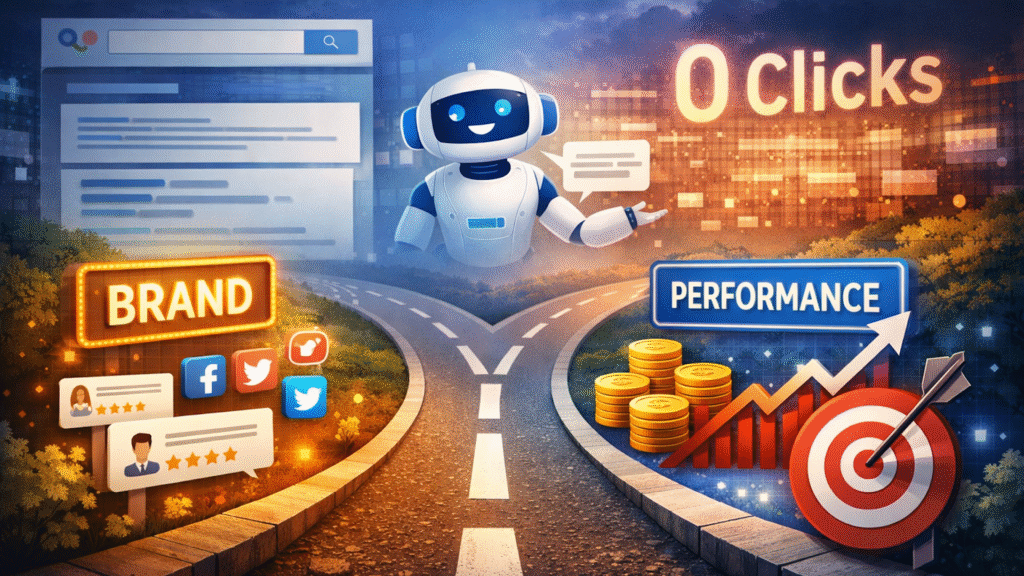

For a long time, SEO had the simplest math in marketing:
- Rank higher → Get more traffic → Fill the sales pipeline
To the dissatisfaction of marketing executives, that linear world is breaking fast.
Between AI Overviews, zero-click SERPs, and users getting answers directly from LLMs, the old “rank to get traffic and leads” equation is failing.
Today, holding a top keyword position often yields significantly fewer clicks than it did just two years ago.
This has forced many uncomfortable conversations in boardrooms. CMOs and CEOs are looking at traffic dashboards and asking tough questions, especially:
- “If traffic is down… how do we know SEO is actually working?”
The answer forces us to confront a hard truth: The traffic model has collapsed, but executives still want measurable ROI.
We have to stop treating SEO like a traffic faucet and start treating it like what it actually is: a brand-dependent performance channel.
Why traffic and pipeline are no longer in lockstep
Linear attribution has never fully captured the reality of organic search.
ChatGPT is not replacing Google; rather, it is expanding its use.
And that’s because users are skeptical of search and LLM results, so they need to validate the information they find on both platforms.
In the past, the research loop happened inside Google’s ecosystem (clicking back and forth between results).
Today, organic search behaves like a pinball machine. Buyers bounce across channels and interfaces in ways that traditional attribution software cannot track.
A user might find an answer in an AI Overview, verify it on Reddit, check a competitor comparison on G2, and finally convert days later via a direct visit.
This complexity has broken the correlation marketing executives are hungry for.
In the past, if you overlaid traffic and pipeline charts, the lines moved together. Now, they often diverge.
Across B2B SaaS portfolios, I am seeing a consistent pattern:
- Organic sessions are flat or declining year over year.
- Rankings for high-intent terms remain stable.
- Pipeline and inbound demos from organic search are going up.

Dig deeper: How to explain flat traffic when SEO is actually working
This divergence doesn’t mean SEO is failing. It means that traffic is no longer a reliable proxy for business impact.
The traffic being lost to zero-click searches is often informational and low-intent. The remaining traffic is higher-intent and closer to conversion.
We are witnessing the “atomization” of search demand.
As Kevin Indig notes in his analysis of The Great Decoupling, demand for short-head, broad keywords is in permanent decline.
Users are either bypassing search entirely for AI interfaces, or they are refining their queries into specific, long-tail questions that have lower volume but significantly higher intent.
The “fat head” of search – the generic terms that used…
Source link
Disclaimer
We strive to uphold the highest ethical standards in all of our reporting and coverage. We blogs.grocliq.com want to be transparent with our readers about any potential conflicts of interest that may arise in our work. It’s possible that some of the investors we feature may have connections to other businesses, including competitors or companies we write about. However, we want to assure our readers that this will not have any impact on the integrity or impartiality of our reporting. We are committed to delivering accurate, unbiased news and information to our audience, and we will continue to uphold our ethics and principles in all of our work. Thank you for your trust and support.
Website Upgradation is going on for any glitch kindly connect at [email protected]