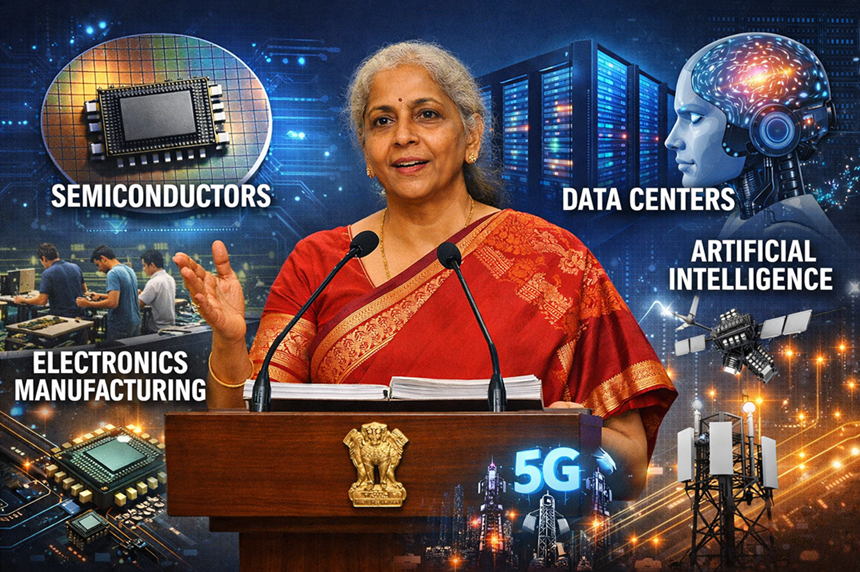

Finance Minister Nirmala Sitharaman presented the Union Budget for 2026–27 in Parliament on February 1, outlining a series of measures affecting semiconductors, electronics manufacturing, telecom, data centres, fintech platforms, artificial intelligence, and digital infrastructure. The announcements focus largely on fiscal incentives, tax certainty, scheme expansions, and infrastructure support, with limited detail on regulation, enforcement capacity, or implementation timelines.
The government has proposed the following key technology-related measures in Budget 2026.
- Electronics manufacturing and components: The budget increases government support for electronics component manufacturing by allocating Rs 40,000 crore to the Electronics Components Manufacturing Scheme (ECMS), up from Rs 22,919 crore last year. The scheme aims to strengthen domestic production of electronic components, an area where India remains heavily import-dependent, though the budget does not specify targets related to output, employment generation, or import substitution.
- Semiconductors and India Semiconductor Mission 2.0: The government announced India Semiconductor Mission (ISM) 2.0, expanding the scope of the semiconductor programme to include manufacturing of semiconductor equipment and materials, development of full-stack Indian intellectual property, strengthening supply chains, and setting up industry-led research and training centres to build skilled manpower. While Rs 1,000 crore has been indicated for industry-led research and training, the Budget does not announce a consolidated or fresh financial outlay for ISM 2.0.
- Data centres and global cloud services: To attract long-term capital and position India as a global data centre hub, the government has offered a tax holiday until 2047 to foreign companies that provide cloud services to global customers using data centres located in India. The budget requires these companies to route services to Indian customers through Indian seller entities. It also proposes a safe harbour margin of around 15% for related-party data centre service arrangements. However, the Budget does not address data localisation requirements, cross-border data flows, or the environmental impact of large-scale data centres.
- IT services and tax certainty: Recognising the interconnected nature of software development, IT-enabled services, Knowledge Process Outsourcing (KPO), and contract R&D, the Budget proposes to club all such activities under a single category called ‘Information Technology Services’, with a common safe harbour margin of 15.5%. The threshold for availing safe harbour has been raised significantly from Rs 300 crore to Rs 2,000 crore, approvals will follow an automated rule-based process, and companies can continue the safe harbour for up to five years, alongside a fast-tracked unilateral Advance Pricing Agreement (APA) process for IT services.
- Telecom sector and public infrastructure: The…
Source link
Disclaimer
We strive to uphold the highest ethical standards in all of our reporting and coverage. We blogs.grocliq.com want to be transparent with our readers about any potential conflicts of interest that may arise in our work. It’s possible that some of the investors we feature may have connections to other businesses, including competitors or companies we write about. However, we want to assure our readers that this will not have any impact on the integrity or impartiality of our reporting. We are committed to delivering accurate, unbiased news and information to our audience, and we will continue to uphold our ethics and principles in all of our work. Thank you for your trust and support.
Website Upgradation is going on for any glitch kindly connect at [email protected]