

Google’s AI Overviews have moved beyond the experimental phase and are now a permanent part of search. To assess their impact, Adthena analyzed data across six major industries from late December 2025 to January 2026, tracking performance metrics from hundreds of thousands of advertisers, including more than 5 million ads.
While aggregate data suggests stability, a deeper look reveals a different picture. For advertisers, these automated summaries are no longer just a visibility concern; they directly threaten PPC revenue.
What AI Overviews mean for paid search revenue
Generative summaries fundamentally change the math of a successful campaign. When an AI Overview pushes paid ads below the fold, it triggers a chain reaction that impacts your profitability:
- Lower CTR = fewer clicks: Reduced visibility leads to fewer visits to your landing pages, shrinking your traffic pipeline.
- Fewer clicks = fewer conversions: A smaller traffic pool inevitably leads to a drop in total lead or sale volume.
- Higher CPC = reduced profitability: In sectors where AI summaries trigger on high-competition terms, the cost to stay relevant rises, squeezing margins and lowering your return on ad spend (ROAS).
AI Overviews impact across six industries
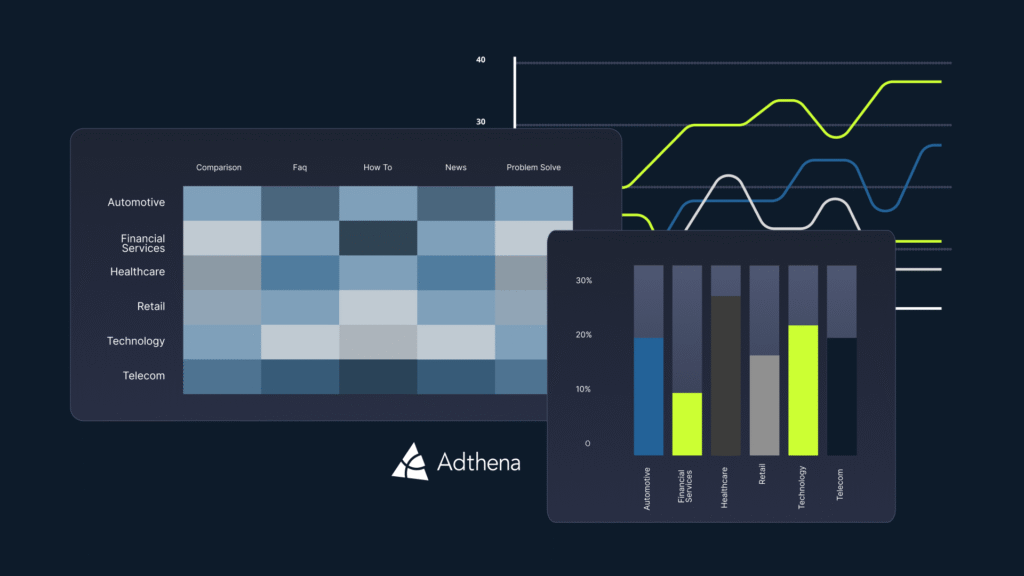
Adthena tracked AI Overview frequency, content themes, and CPC/CTR performance across desktop and mobile. The findings show a fragmented landscape: impact varies by industry, device, query type, and content intent.
Content themes: The battle for mid-funnel intent
Adthena’s analysis shows that Google is increasingly moving into comparison and instructional spaces, directly challenging high-converting paid search territory.

- The comparison conflict: In Telecom, Technology, and Retail, AI Overviews are dominated by comparison content. When Google provides a side-by-side analysis, it satisfies the research phase and may stop users from clicking your ad to learn more.
- The informational buffer: Conversely, Healthcare (74% News) and Financial Services (54% FAQ) see informational themes. These act as intent filters, potentially protecting ad spend by satisfying low-intent users before they reach a paid link.
- The opportunity gap: Problem solving content remains virtually untouched at 0-2%. This is a safe harbour for advertisers: troubleshooting queries are still largely free from AI interference.
CPC trends: The premium for visibility
Tracking CPC fluctuations identifies where advertisers are paying a visibility tax to stay competitive.

- Technology: Queries featuring an AI Overviews consistently show higher CPCs than those without, a clear signal that AI Overview presence is pushing up the cost of visibility.
- Automotive & Retail: Automotive and retail show nearly identical cost levels regardless of AI Overviews presence.
- Financial Services: CPC increases may look modest here, but in a sector where CPCs are already high, the hit to campaign…
Source link
Disclaimer
We strive to uphold the highest ethical standards in all of our reporting and coverage. We blogs.grocliq.com want to be transparent with our readers about any potential conflicts of interest that may arise in our work. It’s possible that some of the investors we feature may have connections to other businesses, including competitors or companies we write about. However, we want to assure our readers that this will not have any impact on the integrity or impartiality of our reporting. We are committed to delivering accurate, unbiased news and information to our audience, and we will continue to uphold our ethics and principles in all of our work. Thank you for your trust and support.
Website Upgradation is going on for any glitch kindly connect at [email protected]