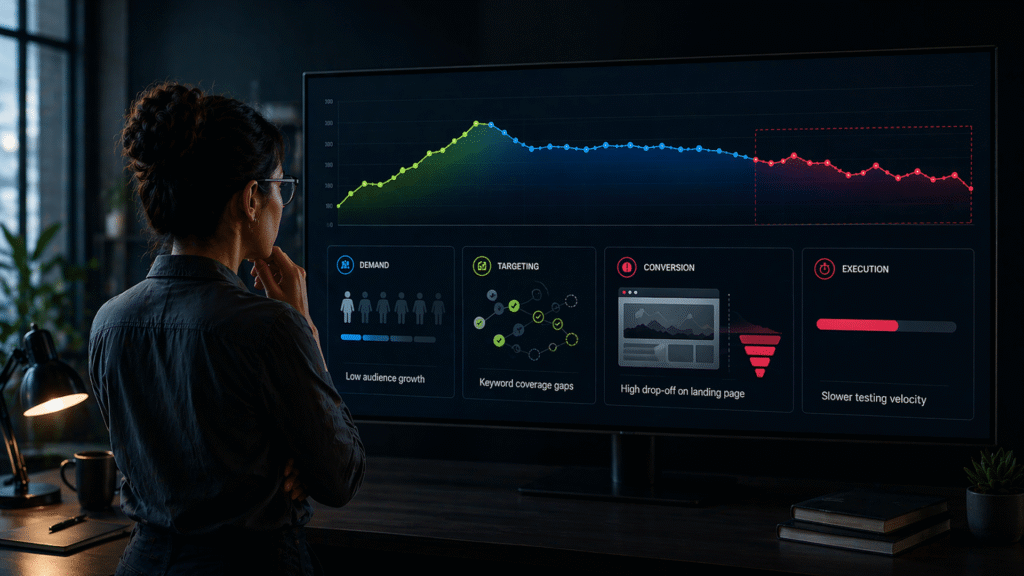

Search campaigns often see strong early gains — more visibility, traffic, and conversions. But that growth doesn’t last forever. At some point, performance stalls, whether it shows up as a plateau, volatility, or rising costs.
That slowdown isn’t necessarily a failure. More often, it signals limits in demand, targeting, conversion, or execution — the challenge is figuring out which one.
Search performance doesn’t stay linear, and once early wins are exhausted, quick gains become harder to find. When growth stalls, the instinct is to do more — launch campaigns, publish content, increase spend. But without understanding the constraint, that effort can miss the mark.
Instead, the goal is to diagnose what’s actually limiting performance so you can focus on the changes that unlock the next phase of growth.
How to identify what’s actually limiting growth
When performance drops off, there’s a natural reaction to do more. The discipline of taking a step back and having a mindset of auditing, or seeking to understand what is really going on, is key to understanding the situation.
While the answer very well may be to launch more campaigns, increase budgets, or publish more content, chances are that it will be a wasted effort and possibly compound the problem. In many cases, time is of the essence, and we don’t have time to spend a month on a forensic audit. Plus, it isn’t always necessary.
A set of questions within a diagnostic framework can quickly help you identify what’s happening.
Where is the change occurring?
This might already be answered, as a specific KPI might have triggered the concern to start with. However, it’s important to understand where the performance gap is happening.
- Is it in just one channel? One platform? Or, more broadly, across the board?
- Where in the funnel or customer journey is it happening? Is it related to visibility, traffic, conversions, or something else?
What hasn’t changed?
Knowing what metrics are stable can help isolate variables in your search for answers. The more you can isolate the issue, the better you can diagnose problems and more quickly get to resolution steps.
Is the issue upstream or downstream?
Digging into upstream items includes demand and targeting, while downstream leads to the website and conversions. Getting granular with where performance is impacted in the journey helps greatly.
Is this a limit or a gap?
Limits can include considering if an opportunity has been maxed out, leading to a plateau. And, gaps can include considering if something is missing or is misaligned in the journey, tech, and end-to-end ecosystem.
Dig deeper: Stop reporting traffic and activity. Start reporting progress.
Your customers search everywhere. Make sure your brand shows up.
The SEO toolkit you know, plus the AI visibility data you need.
Start Free Trial
…
Source link
Disclaimer
We strive to uphold the highest ethical standards in all of our reporting and coverage. We blogs.grocliq.com want to be transparent with our readers about any potential conflicts of interest that may arise in our work. It’s possible that some of the investors we feature may have connections to other businesses, including competitors or companies we write about. However, we want to assure our readers that this will not have any impact on the integrity or impartiality of our reporting. We are committed to delivering accurate, unbiased news and information to our audience, and we will continue to uphold our ethics and principles in all of our work. Thank you for your trust and support.
Website Upgradation is going on for any glitch kindly connect at [email protected]