
Microsoft announced a wave of AI updates this week, and most of the coverage will likely focus on the individual launches. New targeting options, diagnostics, commerce tools, Copilot enhancements, and campaign features will naturally get the headlines.
What stood out to me was the broader vision behind them.
Microsoft is not just talking about better ads. They’re talking about a different internet, where businesses need to be relevant to both people and AI systems helping shape decisions.
In their announcement this week, AI agents are becoming the fastest-growing audience. The company says automated traffic is growing 8x faster than human traffic, AI-driven sessions nearly tripled in 2025, and agentic browser traffic is up roughly 8,000% year over year. Those visitors don’t browse the way people do. They evaluate, select, and act. If a brand’s data is weak, incomplete, or untrusted, they move on.
That changes what modern performance marketing may require. Visibility inside AI answers, stronger product data, better measurement, faster diagnostics, audience precision, and clearer control over automation all start to matter more in that environment.
Google is pushing many of these same themes in its own way, especially around product feeds, automation, and AI-assisted search experiences. But Microsoft’s recent announcements offer a distinct perspective on where advertiser value may come from as discovery and buying behavior continue to shift.
Because underneath the product updates is a bigger question for PPC teams: how do you compete when the next valuable audience may not always be human?
Microsoft Is Selling A Different AI Future
Most platform announcements focus on what a new feature does. Microsoft spent more time explaining why advertiser behavior may need to change.
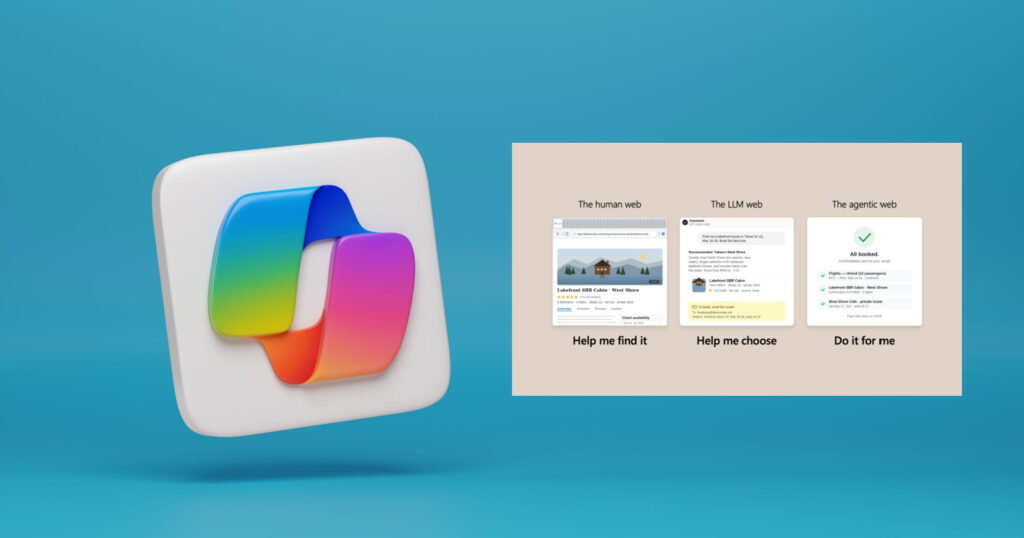
Their framework centered on three parallel realities:
- People still searching on their own (the Human web)
- People using AI to compare options (the LLM web)
- AI systems taking action on behalf of users (the Agentic web)
What they’re saying beyond these parallels is that customer journeys are less linear and are finally being recognized as such.
For years, many PPC teams optimized around the click because the click was the clearest measurable moment. Someone searched, clicked, landed, and converted. That model still matters, but it no longer explains every influence that leads to a sale.
If an AI assistant narrows the shortlist before a search happens, the brand has already won or lost ground. If a shopping assistant compares shipping speed, loyalty perks, and product availability in seconds, the decision may be shaped before the landing page visit. If an agent eventually completes more transactions directly, structured data and transaction readiness become part of media performance.
That is why this announcement deserves more attention than a standard product roundup. Microsoft is describing a future where paid media performance depends on more than media settings.
Source link
Disclaimer
We strive to uphold the highest ethical standards in all of our reporting and coverage. We blogs.grocliq.com want to be transparent with our readers about any potential conflicts of interest that may arise in our work. It’s possible that some of the investors we feature may have connections to other businesses, including competitors or companies we write about. However, we want to assure our readers that this will not have any impact on the integrity or impartiality of our reporting. We are committed to delivering accurate, unbiased news and information to our audience, and we will continue to uphold our ethics and principles in all of our work. Thank you for your trust and support.
Website Upgradation is going on for any glitch kindly connect at [email protected]