
First, they learned how to play tennis on two feet. Then, they came for our half-marathon world record.
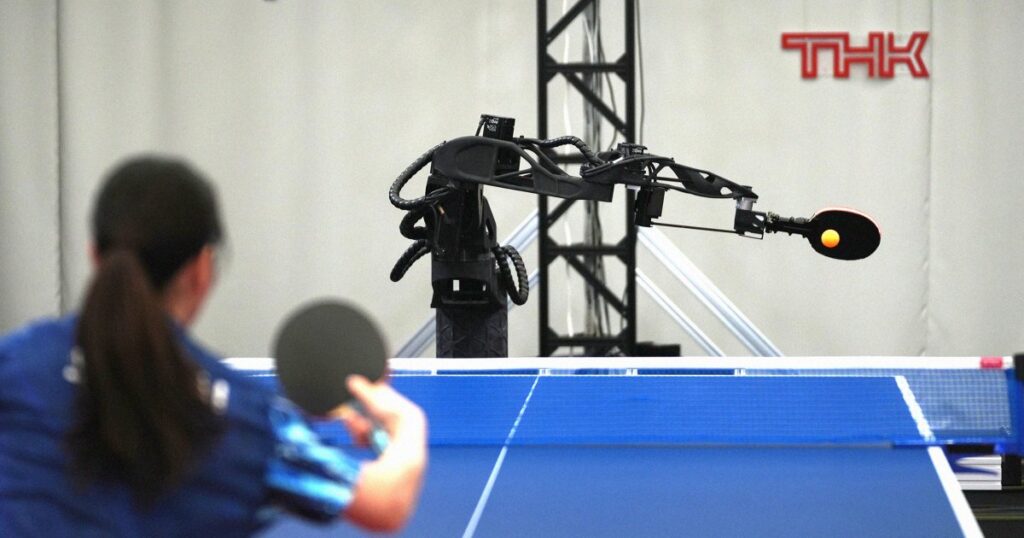
Now, robots are set to overtake us in the sport of table tennis as well. In a recent paper, published this week in the journal Nature, researchers detailed how they’ve leveraging AI to teach a robot arm built by Sony, dubbed Ace, to repeatedly beat “elite and professional players under official competition rules.”
Sony claims it’s the first robot to achieve expert-level performance in any competitive physical sport, following decades of table tennis robot development.
A promotional video put together by Sony’s AI division shows the paddle-wielding robot bounding back and forth at staggering speeds to counter aggressive strikes. The human experts don’t appear to be holding back, either, smacking challenging shots at it with full strength.

Project Ace
It’s an impressive technological feat and a major milestone for the application of AI in robotics, a confluence of two areas of research that has been at the core of the ongoing boom in humanoid robotics over the last few years.
While teaching a robot arm to play ping pong may not sound like the kind of thing that will lead to the next industrial revolution, many of Ace’s achievements could eventually trickle down to other areas of research.
“The success of Ace, with its perception system and learning-based control algorithm, suggests that similar techniques could be applied to other areas requiring fast, real-time control and human interaction,” lead author and project lead at Sony AI Peter Dürr told Reuters, “such as manufacturing and service robotics, as well as applications across sports, entertainment and safety-critical physical domains.”
According to their paper, Ace won three out of five games against elite players with more than ten years of experience, but lost two games against top-level pros as of April 2025. However, Sony claims that Ace went on to beat more professional players in December, as well as last month.
The level of complexity is staggering. The robot needs to have extremely fast reaction times, not only to track the ball, but to also determine its trajectory in real-time using nine cameras and three vision systems.
The overall system can “track a ball at 200 Hz with millimeter accuracy and around ten millisecond latency while measuring the spin at up to 700 Hz,” explains an accompanying Sony AI blog post. “This is fast enough to capture motion that would be a blur to the human eye.”
Deep reinforcement learning allows it to seamlessly predict ball behavior and choose how to counter its opponent.
Meanwhile, many high-level players were baffled by…
Source link
Disclaimer
We strive to uphold the highest ethical standards in all of our reporting and coverage. We blogs.grocliq.com want to be transparent with our readers about any potential conflicts of interest that may arise in our work. It’s possible that some of the investors we feature may have connections to other businesses, including competitors or companies we write about. However, we want to assure our readers that this will not have any impact on the integrity or impartiality of our reporting. We are committed to delivering accurate, unbiased news and information to our audience, and we will continue to uphold our ethics and principles in all of our work. Thank you for your trust and support.
Website Upgradation is going on for any glitch kindly connect at [email protected]