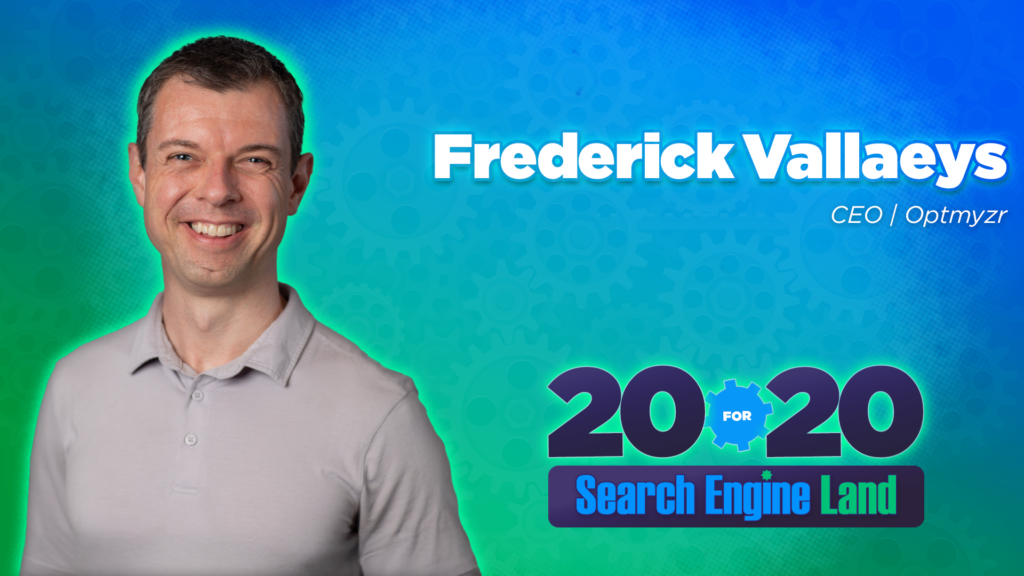

Frederick Vallaeys’ route into PPC started with a student side hustle, not a career plan.
While at Stanford in 1998, he spotted a resale opportunity in used Blockbuster video cassettes and needed a way to find buyers. That led him to GoTo, an early search engine where advertisers could bid on keywords – and gave him his first glimpse of the power of paid search.
More than 20 years later, Vallaeys has become one of the best-known voices in PPC, a former Googler, one of the early builders in the Google Ads ecosystem, and founder of Optmyzr.
In this interview, he looks back at the early days of Google Ads, how automation changed everything, and what marketers need to remember as search moves from keywords to prompts.
Paid search started with a simple idea
Vallaeys’ first “aha” moment came before Google Ads became the giant it is today.
Goto showed him that you didn’t need a huge budget to reach an audience. You could buy a keyword, get traffic and test whether something worked.
That was a major shift from traditional advertising, where budgets were bigger and measurement was weaker.
Paid search made advertising accessible.
Google Ads made performance measurable
When Vallaeys joined Google in 2002, he helped launch Google Ads in Dutch, the sixth language supported by the platform.
At the time, a top-tier advertiser was spending around $30,000 a month — a number that feels modest today, but was significant then.
What made Google different was not just traffic. It was proof.
The acquisition of Urchin, which became Google Analytics, and the development of conversion tracking gave advertisers visibility into what happened after the click.
That changed paid search from something that seemed to work into something advertisers could prove worked.
Search Engine Land helped shape the industry
By the time Search Engine Land launched in 2006, paid search had already become a serious advertising channel.
For Vallaeys, Search Engine Land became more than a news source. It became a place to share ideas, learn from others and build connections.
In fact, Optmyzr started because of a Search Engine Land article.
Vallaeys had written about quality score and shared a script to calculate account-level quality score. His future co-founders commented on the article, they connected, and within half an hour of talking, decided to build what became Optmyzr.
Quality score was always about relevance
Quality score has been one of the defining features of Google Ads.
In the earliest days, Vallaeys said, it was essentially click-through rate. Google needed a way to make sure ads were not just high-bid, but relevant.
That balance between bid and quality became foundational to the auction.
Before machine learning handled much of that work, humans were heavily involved. Vallaeys even reviewed keywords himself and could disapprove…
Source link
Disclaimer
We strive to uphold the highest ethical standards in all of our reporting and coverage. We blogs.grocliq.com want to be transparent with our readers about any potential conflicts of interest that may arise in our work. It’s possible that some of the investors we feature may have connections to other businesses, including competitors or companies we write about. However, we want to assure our readers that this will not have any impact on the integrity or impartiality of our reporting. We are committed to delivering accurate, unbiased news and information to our audience, and we will continue to uphold our ethics and principles in all of our work. Thank you for your trust and support.
Website Upgradation is going on for any glitch kindly connect at [email protected]