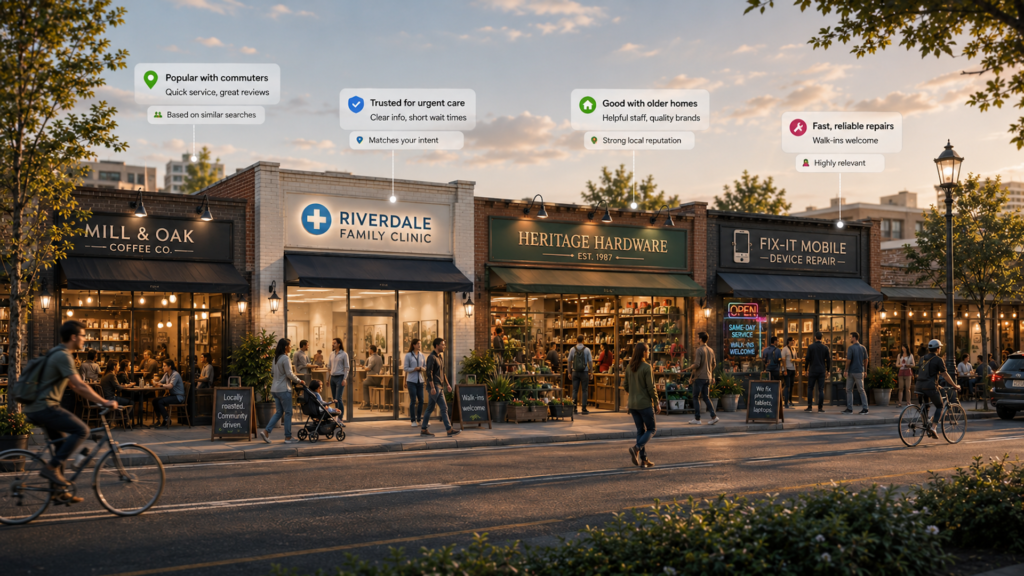

Understanding how to optimize for visibility in Google Ask Maps starts with recognizing what’s changing. Instead of returning a long list of businesses, Ask Maps narrows the field, interprets the user’s intent, and explains why certain businesses are a good fit.
That shift has an important implication. Visibility in Ask Maps now depends on how a business is understood and positioned within the response. If Ask Maps is more recommendation-driven, what should businesses and SEOs do differently?
At a high level, the answer is not to treat Ask Maps as a separate tactic. It’s to make your business easier for Google to understand, easier to match to real-world situations, and easier to trust. The fundamentals of local SEO still apply, but the way those signals come together matters more.
Visibility in Ask Maps is a filtering problem first
One of the most noticeable differences in Ask Maps is how limited the result set is.
Across testing, around 3-8 businesses were shown, depending on the query. That’s a very different experience from traditional Maps, where users can scroll through dozens of options and do their own comparisons.

Here, that comparison happens earlier in the process. Instead of presenting a wide set of options and letting users filter them down, Ask Maps does that filtering up front. It narrows the field, interprets the request, and presents a smaller group of businesses, along with an explanation of why each fits.
That changes what it means to be visible.
It’s no longer enough to show up somewhere in a longer list, preferably in the top three. The goal becomes making that smaller set of recommended businesses. That introduces a second layer beyond ranking: Google needs enough confidence to include your business and explain why it belongs there.

A useful way to think about this is that Ask Maps is solving two problems at once.
- First, it decides which businesses are eligible.
- Then, it decides which of those businesses it can confidently recommend.
Dig deeper: Google Ask Maps is moving from listings to recommendations
Your customers search everywhere. Make sure your brand shows up.
The SEO toolkit you know, plus the AI visibility data you need.
Start Free Trial
Get started with

Ask Maps needs enough information to explain your business

Another consistent pattern is that Ask Maps doesn’t just list businesses. It interprets and describes them.
Even for relatively simple queries, businesses are described in terms of qualities like responsiveness, experience, specialization, or the types of situations they seem well-suited for. As queries become more specific or more tied to trust and decision-making, that framing becomes more central to the response.
This creates a different kind of requirement for optimization.
It’s not enough for Google to know that…
Source link
Disclaimer
We strive to uphold the highest ethical standards in all of our reporting and coverage. We blogs.grocliq.com want to be transparent with our readers about any potential conflicts of interest that may arise in our work. It’s possible that some of the investors we feature may have connections to other businesses, including competitors or companies we write about. However, we want to assure our readers that this will not have any impact on the integrity or impartiality of our reporting. We are committed to delivering accurate, unbiased news and information to our audience, and we will continue to uphold our ethics and principles in all of our work. Thank you for your trust and support.
Website Upgradation is going on for any glitch kindly connect at [email protected]