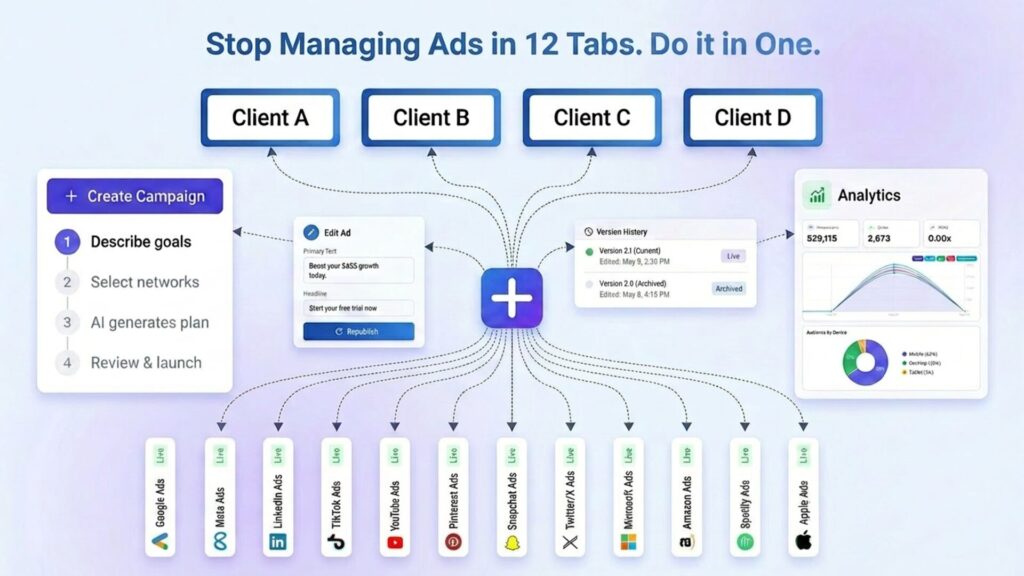


Ask any paid media manager how their Monday morning starts, and you’ll hear some version of the same story.
Google Ads. Meta. LinkedIn. TikTok. Reddit. Pull the numbers, drop them into a spreadsheet, make them tell a coherent story, and send the report to your client or boss by 10 a.m. Somewhere in there, figure out what worked last week and why.
It’s a terrible use of a Monday morning.
I’ve been in performance marketing long enough to remember when “multi-channel” meant running Google Ads and maybe a Facebook campaign on the side. That was already hard enough to reconcile. Now you’re dealing with 10 or 11 networks, each with its own attribution logic, campaign structure, and definition of a conversion.
The data doesn’t just live in different places. It doesn’t even speak the same language.
And yet most teams still manage everything the same way they did five years ago: too many tabs, spreadsheets, and Monday mornings.
The Monday morning problem nobody talks about
What doesn’t get discussed enough is that most of the time paid media teams spend on “campaign management” isn’t actually campaign management. It’s
- Data entry.
- Reformatting.
- Logging in and out of platforms.
- Rebuilding the same campaign brief five different times because Google’s campaign structure doesn’t map to Meta’s, and neither of them map to LinkedIn’s.
Industry data puts the average paid media manager at 5 to 9 hours a week on administrative work alone. My sense from talking to practitioners — and from doing the job myself — is that’s probably conservative for anyone managing more than three or four active networks. Agencies handling multiple clients across multiple platforms can easily spend twice that.
Think about what 10 hours a week actually means. That’s 40 hours a month — five full working days.
If you’re billing that time to clients, a meaningful part of the retainer isn’t going toward the work they actually hired you to do. If you’re absorbing it internally, it’s a hidden cost that never shows up in your ROAS calculations but absolutely shows up in your margins.
Every week.
And that’s before you get to the errors. Manual data transfer is really just manual error introduction — there’s no way around it.
- Budget caps get mistyped.
- Negative keyword lists don’t get updated across platforms.
- A campaign gets paused in Google while it keeps running in Meta because nobody caught it.
Small things, but small things compound.

What you’re actually losing (it’s not just time)
The time cost is real, but it’s not even the biggest problem. The bigger issue is the lag.
When your performance data lives in 12 different places and only gets consolidated once a week, you miss a meaningful optimization window between Monday and Friday.
The insight that LinkedIn is overspending while Google is underspending doesn’t surface…
Source link
Disclaimer
We strive to uphold the highest ethical standards in all of our reporting and coverage. We blogs.grocliq.com want to be transparent with our readers about any potential conflicts of interest that may arise in our work. It’s possible that some of the investors we feature may have connections to other businesses, including competitors or companies we write about. However, we want to assure our readers that this will not have any impact on the integrity or impartiality of our reporting. We are committed to delivering accurate, unbiased news and information to our audience, and we will continue to uphold our ethics and principles in all of our work. Thank you for your trust and support.
Website Upgradation is going on for any glitch kindly connect at [email protected]