
Your Google Ads account is going to start serving a buyer you cannot see. That buyer is an AI agent that compares products and goes through checkout on your customer’s behalf.
Agentic commerce is going to be the biggest structural change to ecommerce paid media since mobile, and it is already moving real money. During Cyber Week 2025, Salesforce attributed roughly $67 billion in global sales, about 20% of all orders, to AI and agents. That wasn’t an estimate or forecast for next year; that was last holiday season.
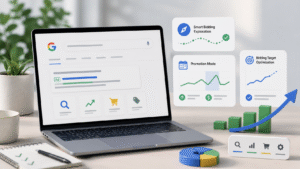
Your product feed is now turning into a bidding signal instead of a catalog, and a new paid surface opens inside Google’s AI Mode. Performance Max and Shopping start placing into that surface directly, and your conversion tracking breaks in ways that depend on how the agent checks out. This is going to be a bumpy ride.
None of this means your current campaigns stop working. It means the inputs that decide whether you win are shifting, and the accounts that adjust early get a real edge.
What’s The Latest In Agentic Commerce
A quick grounding, because this space moves fast and the headlines blur together.
Google’s agentic checkout, branded Buy for Me, is live in AI Mode with launch partners including Wayfair, Chewy, and Quince. At NRF 2026, Google introduced the Universal Commerce Protocol, an open standard built with Shopify, Etsy, Walmart, and Target, and endorsed by more than 20 companies, including Visa and American Express. OpenAI shipped Instant Checkout in ChatGPT on its own protocol built with Stripe. Perplexity paired with PayPal. Visa, Mastercard, and Stripe all rolled out agent-ready payment rails.
When discovery, checkout, and payments all reorganize around agents within 12 months, this is not a pilot you wait out.
→ Read more: Selling To AI: The Complete Guide To Agentic Commerce
Your Feed Is Now A Google Ads Bidding Signal
In Shopping and Performance Max, your product feed already drives matching and bidding. Agents push that further. When an AI agent evaluates products, it does not read your ad copy or your creative. It reads structured data, the price, availability, shipping, returns, and specs in your feed, and it decides whether you make the shortlist before a human sees anything.
OpenAI’s own evaluation of its shopping research tool makes the point. The tool hit 52% product accuracy on multi-constraint queries against 37% for standard ChatGPT search, where product accuracy measures how well results match requirements like price, color, material, and specs. Buyers are handing agents hard constraints, and the agent is matching those constraints against your feed fields.
Google has noticed where the lever sits. It released new Merchant Center attributes specifically to help products get surfaced in conversational shopping.
The takeaway for a paid team is uncomfortable but simple. Feed quality is now a bidding issue, not a hygiene issue. If your feed is owned by whoever set up Merchant Center two years…
Source link
Disclaimer
We strive to uphold the highest ethical standards in all of our reporting and coverage. We blogs.grocliq.com want to be transparent with our readers about any potential conflicts of interest that may arise in our work. It’s possible that some of the investors we feature may have connections to other businesses, including competitors or companies we write about. However, we want to assure our readers that this will not have any impact on the integrity or impartiality of our reporting. We are committed to delivering accurate, unbiased news and information to our audience, and we will continue to uphold our ethics and principles in all of our work. Thank you for your trust and support.
Website Upgradation is going on for any glitch kindly connect at [email protected]