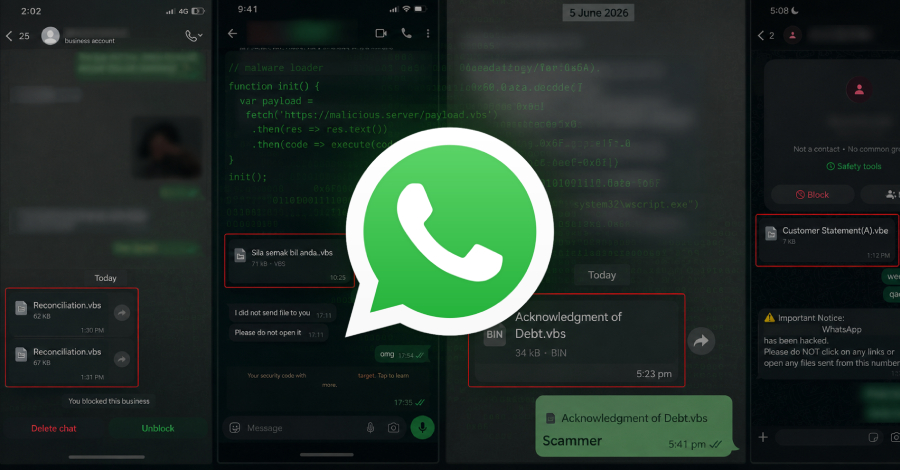


Direct messages sent via WhatsApp are being used to distribute malicious Visual Basic Script (VBScript) files that lead to the installation of legitimate Remote Monitoring and Management (RMM) software.
Per findings from Kaspersky, the active campaign is targeting users of WhatsApp Desktop and WhatsApp Web across Malaysia, Brazil, India, Mexico, Singapore, the U.K., Spain, Taiwan, Australia, Russia, and Vietnam. The highest concentration of victims has been reported in Malaysia.
“The threat actor uses deceptive file names masquerading as business and financial documents to persuade recipients to download and execute the attachment,” security researcher Fareed Radzi said. “Once executed, the VBScript initiates a multi-stage infection chain that ultimately results in the installation of legitimate Remote Monitoring and Management (RMM) software, enabling remote access to the victim’s system.”
It’s suspected that the threat actor behind the operation managed to obtain surreptitious access to several WhatsApp accounts and then used them as a distribution vector for the VBScript files across their contacts. That said, exactly how these accounts are compromised is unclear.
The heavily obfuscated VBScript files are dressed up as seemingly harmless business and financial documents, using names like “Financial Reports.vbs” or “Account Statement.vbs.” Some of the files are also named in other languages, such as Portuguese, French, German, and Malay, reflective of the global nature of the campaign.
“In addition, the VBScript samples contain extensive comments and metadata intended to mimic legitimate Microsoft Windows Update components,” Kaspersky explained. “Many of these comments are written in Chinese and include references to Windows Update modules, certificate validation, system integrity checks, and deployment-related functionality.”
The VBScript file is launched using “WScript.exe,” which then fetches and runs additional VBScript components required for the next stages of the attack. It’s worth noting that the infection chain behaves a little differently based on whether a victim is using WhatsApp Web or the WhatsApp Desktop application.

In the case of the former, the attack relies on the user downloading the file to their system and then opening it from the downloaded folder or via the browser’s download history, assuming it to be a legitimate document. In WhatsApp Desktop, the malware is executed directly within the application, with the process tree revealing that “WhatsApp.Root.exe,” the background process associated with the client application, is responsible for spawning “WScript.exe.”
The primary objective of the VBScript is to download two secondary VBScript payloads from a remote server, one of which attempts to tamper with Windows User Account Control (UAC) behavior, while the other downloads and executes a ZIP file containing the installation package for…
Source link
Disclaimer
We strive to uphold the highest ethical standards in all of our reporting and coverage. We blogs.grocliq.com want to be transparent with our readers about any potential conflicts of interest that may arise in our work. It’s possible that some of the investors we feature may have connections to other businesses, including competitors or companies we write about. However, we want to assure our readers that this will not have any impact on the integrity or impartiality of our reporting. We are committed to delivering accurate, unbiased news and information to our audience, and we will continue to uphold our ethics and principles in all of our work. Thank you for your trust and support.
Website Upgradation is going on for any glitch kindly connect at [email protected]