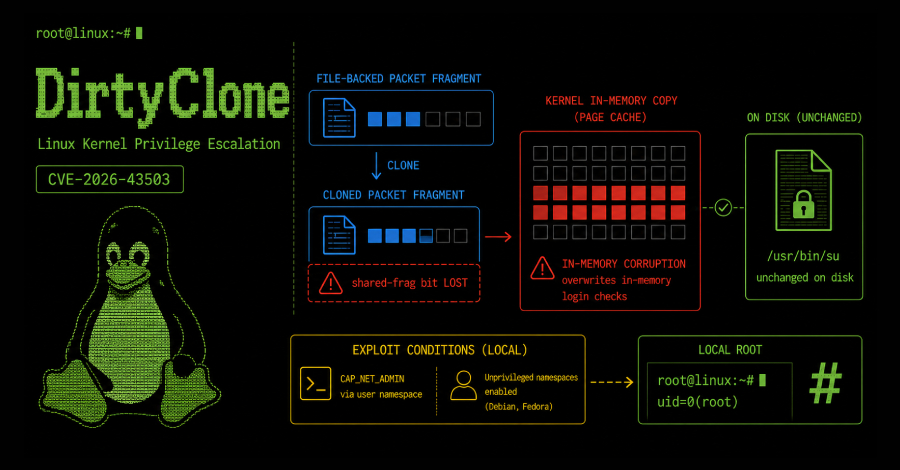


DirtyClone is a new Linux kernel privilege escalation in the DirtyFrag family. JFrog Security Research published a working exploit walkthrough for the flaw on June 25, the first public demonstration for this variant.
Tracked as CVE-2026-43503 (CVSS 8.8), it lets a local user corrupt file-backed memory through a cloned network packet and gain root. The patch landed in mainline on May 21; if your kernel does not have it, update now.
When the kernel copies a network packet internally, two helper functions drop a safety flag that marks the packet’s memory as shared with a file on disk. That missing flag is the entire vulnerability.
The attacker loads a privileged binary like /usr/bin/su into memory, wires those memory pages into a network packet, and forces the kernel to clone it. The cloned packet passes through an IPsec tunnel that the attacker controls, and the decryption step overwrites the binary’s login checks with attacker-chosen bytes. The next time anyone runs su, it hands over root.
The file on disk never changes. The modification lives only in the kernel’s in-memory copy, so file-integrity tools miss it, the attack leaves no audit trail, and a reboot restores the original binary. The attacker already has root by the time anyone might think to check.
Exploitation requires CAP_NET_ADMIN to configure the loopback IPsec tunnel. On Debian and Fedora, unprivileged user namespaces are enabled by default, so a local user can obtain that capability inside a new namespace.
Ubuntu 24.04 and later restrict namespace creation via AppArmor, blocking the default exploit path. Page cache is shared at the host level, so modifications made inside a namespace affect every process on the machine.
The exposed systems are multi-tenant servers, CI runners, container hosts, and Kubernetes clusters where untrusted users can create namespaces. JFrog confirmed the exploit on Debian, Ubuntu, and Fedora systems with default namespace configurations.
Fourth in a Series

This is the fourth recent privilege escalation with the same failure mode: file-backed memory gets treated as packet data, then an in-place network operation writes where it should have copied.
- Copy Fail (CVE-2026-31431) came first in late April, exploiting the algif_aead module for a four-byte page-cache write.
- DirtyFrag (CVE-2026-43284 and CVE-2026-43500) followed on May 7, chaining IPsec ESP and RxRPC paths for a full write primitive.
- Fragnesia (CVE-2026-46300) appeared on May 13, bypassing the DirtyFrag patch through a flag-dropping bug in skb_try_coalesce().
Each fix closed one code path and left others open. DirtyClone’s demonstrated exploit centers on __pskb_copy_fclone(), with skb_shift() also affected; the broader CVE fix covers additional frag-transfer helpers where the same flag could be lost.
The underlying problem is not one bad helper function. It is a contract problem: every code path that moves…
Source link
Disclaimer
We strive to uphold the highest ethical standards in all of our reporting and coverage. We blogs.grocliq.com want to be transparent with our readers about any potential conflicts of interest that may arise in our work. It’s possible that some of the investors we feature may have connections to other businesses, including competitors or companies we write about. However, we want to assure our readers that this will not have any impact on the integrity or impartiality of our reporting. We are committed to delivering accurate, unbiased news and information to our audience, and we will continue to uphold our ethics and principles in all of our work. Thank you for your trust and support.
Website Upgradation is going on for any glitch kindly connect at [email protected]