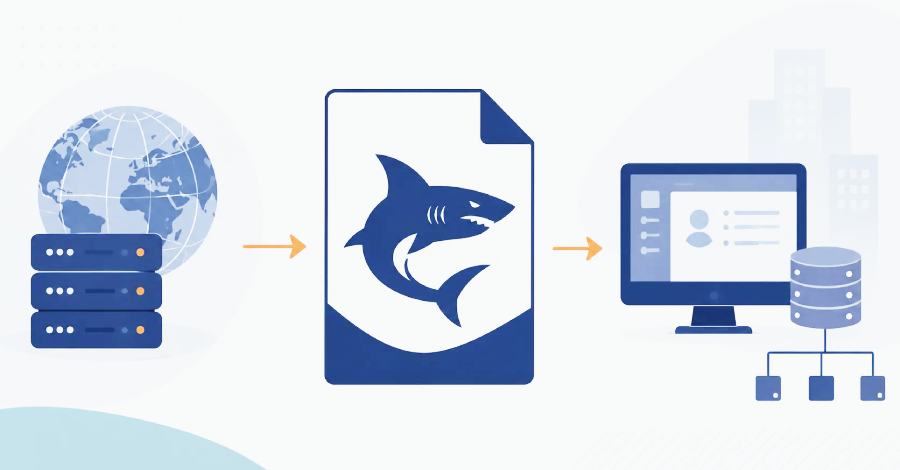


A newly discovered cyber attack campaign has been observed delivering a previously undocumented malware family called SharkLoader that acts as a loader for deploying Cobalt Strike Beacon on compromised hosts.
Kaspersky, which is tracking the activity under the moniker StrikeShark, said the campaign has targeted a diplomatic organization in Indonesia, government organizations in Taiwan, software development companies across multiple countries, and entities associated with other sectors located in Hong Kong, Lebanon, Syria, Colombia, North Macedonia, Nepal, and Serbia.
“The observed victimology suggests a campaign with broad geographic reach and a diverse target set rather than a narrow focus on a specific industry or region,” the Russian cybersecurity vendor said.
The campaign does not exhibit direct links to any known threat actor or group, although the operators have utilized several open-source post-compromise tools like FScan and Pillager, commonly put to use by Chinese-speaking developers. It’s believed that the campaign is the handiwork of a Chinese-speaking threat actor.
Attack chains involve the two initial access pathways: the exploitation of known Exchange Server flaws, such as CVE-2021-26855 (aka ProxyLogon), to strike the Indonesian diplomatic entity, or through a path traversal vulnerability impacting Openfire (CVE-2023-32315) in the case of Taiwanese software development organizations, or a critical remote code execution bug in GeoServer (CVE-2024-36401) to target a Colombian organization.
Other remote code execution and authentication bypass vulnerabilities weaponized by the threat actor are listed below –
It’s assessed that the threat actors are likely employing publicly available proof-of-concept (PoC) exploits hosted on GitHub or other open-source platforms to gain initial access in an opportunistic manner. Upon gaining a foothold, the threat actors establish persistence by deploying web shells to trigger a DLL side-loading chain involving “SystemSettings.exe” (CVE-2021-27076) to deliver SharkLoader (“SystemSettings.dll”).

A second method used by StrikeShark to distribute the loader is via custom dropper executables masquerading as legitimate software installers or applications like Google Update and Cisco AnyConnect, and executing the malware loader once the installation process completes. The method by which these droppers are delivered is currently unknown.
“In addition to installer-themed lures, several SharkLoader droppers use decoy PDF documents to persuade victims to open the malicious file,” Kaspersky explained. “However, not all samples employ this technique, as some droppers function solely as a delivery mechanism for SharkLoader without presenting any lure content.”
Once the DLL is loaded, SharkLoader implements what’s called Perfect DLL Hijacking, a technique detailed by security researcher Elliot Killick in October 2023, to execute malicious code while bypassing Windows Loader Lock, a system-wide…
Source link
Disclaimer
We strive to uphold the highest ethical standards in all of our reporting and coverage. We blogs.grocliq.com want to be transparent with our readers about any potential conflicts of interest that may arise in our work. It’s possible that some of the investors we feature may have connections to other businesses, including competitors or companies we write about. However, we want to assure our readers that this will not have any impact on the integrity or impartiality of our reporting. We are committed to delivering accurate, unbiased news and information to our audience, and we will continue to uphold our ethics and principles in all of our work. Thank you for your trust and support.
Website Upgradation is going on for any glitch kindly connect at [email protected]