

A use-after-free bug in Linux’s KVM hypervisor can be triggered from a guest virtual machine to corrupt the shadow-page state of the host kernel that runs it.
Dubbed ‘Januscape‘ and tracked as CVE-2026-53359, the flaw sits in the shadow MMU code that KVM shares across both Intel and AMD. The public proof-of-concept panics the host; the researcher claims that a separate, unreleased exploit turns the same bug into full host code execution.
Security researcher Hyunwoo Kim (@v4bel) found and reported the bug. He described Januscape as the first guest-to-host exploit triggerable on both Intel and AMD, to the best of public knowledge. The flaw went unnoticed for roughly 16 years.
According to Kim, the exploit was used as a zero-day submission in Google’s kvmCTF, the controlled KVM vulnerability reward program that offers up to $250,000 for full guest-to-host escapes.
How It Works
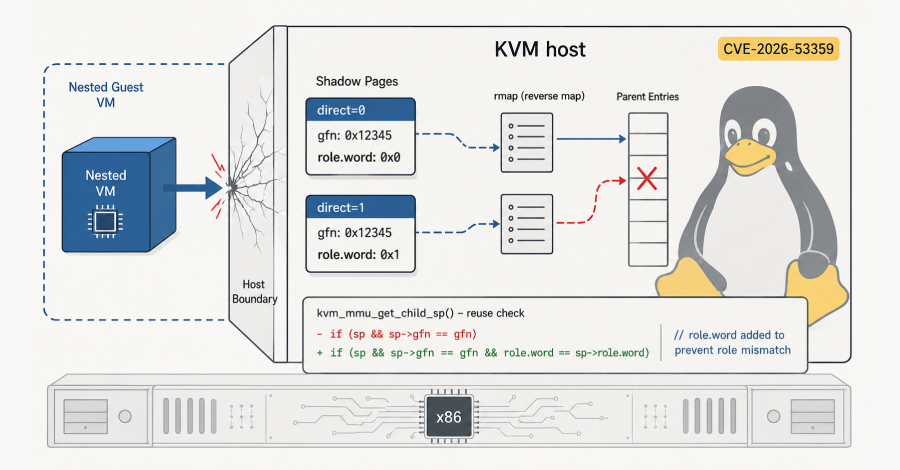
To run a virtual machine, KVM keeps its own private set of page tables that mirror the guest’s memory layout. When it needs one of these tracking pages, it looks for an existing one to reuse.
The problem: it matched them by memory address alone and ignored what type of tracking page it was grabbing. Two different types can share the same address but do completely different jobs, so KVM would sometimes reuse the wrong kind.
That mix-up scrambles KVM’s internal records of which page belongs where, and once those records are wrong, something has to give.
Most of the time, the kernel notices the mess and shuts itself down on the spot to avoid doing damage. That crash is what the public demonstration triggers: a guest can knock over the whole host, taking every other VM on that machine down with it.
The rarer, worse case happens when the freed tracking page gets handed out for another use before the kernel cleans up. The cleanup then scribbles a value into memory it no longer owns. An attacker only controls where that write lands, not what gets written, but even that limited foothold can be worked up into running code on the host.

The flaw behaves the same on Intel and AMD chips; only the final, hardest step of turning it into full control takes different work on each.
Who Is Affected
The vulnerable code has been present since commit 2032a93d66fa in August 2010 (kernel 2.6.36 era) and was fixed by commit 81ccda30b4e8, merged into mainline on June 19, 2026.
The attack requires two things from the guest side: root inside the VM, a common condition on rented cloud instances, and nested virtualization exposed by the host. Even on hosts that run hardware EPT or NPT by default, nested virtualization forces KVM back through the legacy shadow MMU, which is where the bug sits.
The exploit needs no cooperation from QEMU or any userspace VMM. It is purely an in-kernel KVM bug.
The practical concern is any x86 environment that hosts untrusted guests with nested virtualization enabled. An attacker who rents a single such instance can panic the host, taking down every…
Source link
Disclaimer
We strive to uphold the highest ethical standards in all of our reporting and coverage. We blogs.grocliq.com want to be transparent with our readers about any potential conflicts of interest that may arise in our work. It’s possible that some of the investors we feature may have connections to other businesses, including competitors or companies we write about. However, we want to assure our readers that this will not have any impact on the integrity or impartiality of our reporting. We are committed to delivering accurate, unbiased news and information to our audience, and we will continue to uphold our ethics and principles in all of our work. Thank you for your trust and support.
Website Upgradation is going on for any glitch kindly connect at [email protected]