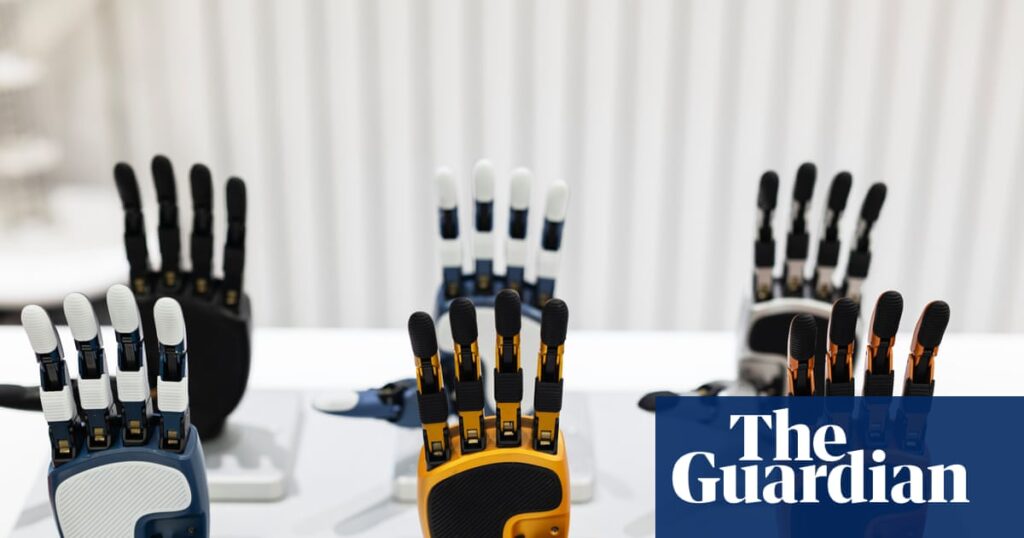

Human hands – nimble, nerve-filled appendages that are the most flexible part of the human skeleton – are exceptionally complex. Many tasks that most people can do largely without thinking, from tying a pair of shoelaces to buttoning up a shirt, in fact require a complex set of neurological instructions and precise choreography. In thousands of years of human history, no machine has been able to truly replicate human’s greatest tool.
But now, as artificial intelligence (AI) races forwards, some companies think they are close to surpassing this final but most difficult hurdle in robotics. Most of them are in China.
A new suite of Chinese start-ups are leveraging China’s advantages in manufacturing and enthusiasm for what the government calls “embodied AI” to build the fully dextrous robotic hands that are needed to transform humanoid robots from dancing gimmicks into useful products.
Ever since Unitree’s troupe of dancing humanoids tottered on to the stage at 2025’s Spring Gala, the annual variety show televised at Lunar New Year, China has been going gaga for robots.
Technologists and policymakers see robotics as the key to unlocking China’s future economic potential as it grapples with an ageing and shrinking workforce. Marketing materials for robotic companies show their products performing all kinds of tasks that humans will supposedly soon be free of: folding laundry, cooking, cutting hair.
Beijing has repeatedly emphasised the importance of “embodied AI” in China’s development plans. In May, the Chinese Communist party’s theoretical journal, Qiushi, published a report that said “embodied-intelligence robots” were among the sectors “opening up new trillion-yuan markets”.
But although China is racing ahead in the deployment of automatons – more than half of the factory robots that are installed each year are in China – the use cases for humanoids remain minimal. “True multipurpose humanoids are far off yet,” concluded the International Federation of Robotics in a report published last September.
That is because many of the tasks that would make humanoids useful in daily settings require human-like hands. And making them is extremely difficult. Last year, Elon Musk, whose company Tesla makes the Optimus humanoid, said hands represented the “majority of the engineering difficulty of the entire robot”.
‘100 times more difficult’
In an office brimming with writhing, floating robotic hands of various weights and sizes, the founder of LinkerBot, one of China’s leading dextrous hands companies, explains the challenge.
Making a robotic hand is “one hundred times more difficult” than making a humanoid, Zhou Yong says. “Its dexterity is 10 times that of other body parts. But its volume is only one tenth of other body parts”.
Source link
Disclaimer
We strive to uphold the highest ethical standards in all of our reporting and coverage. We blogs.grocliq.com want to be transparent with our readers about any potential conflicts of interest that may arise in our work. It’s possible that some of the investors we feature may have connections to other businesses, including competitors or companies we write about. However, we want to assure our readers that this will not have any impact on the integrity or impartiality of our reporting. We are committed to delivering accurate, unbiased news and information to our audience, and we will continue to uphold our ethics and principles in all of our work. Thank you for your trust and support.
Website Upgradation is going on for any glitch kindly connect at [email protected]