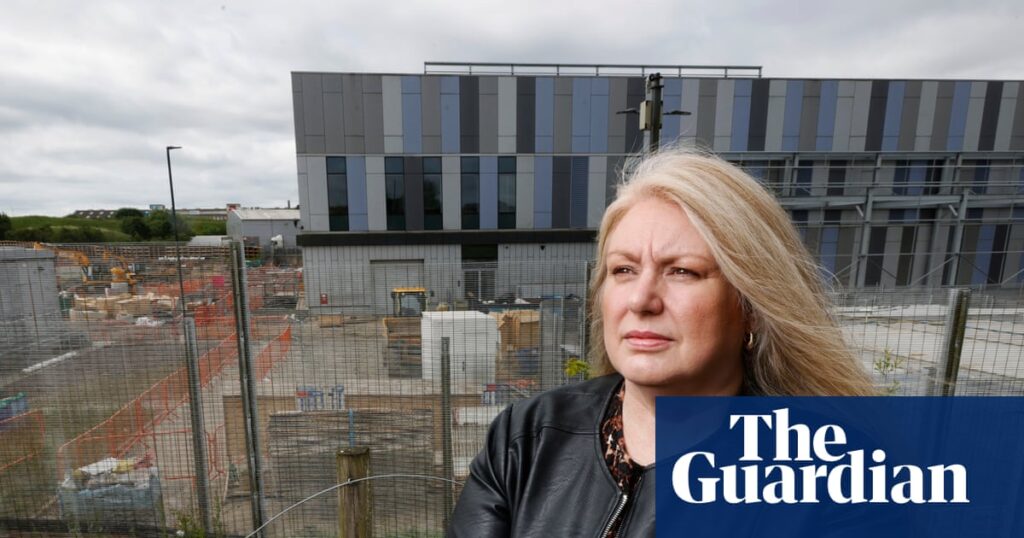

The promise was that a Scottish community would be transformed by massive investment and empowered to chase “the jobs of the future”. Instead, local people in Lanarkshire fear they may have to sell their properties and lose green belt land because of the errors of a badly planned AI datacentre complex, even as those jobs and investments never arrive.
Late last year, representatives of Oakes Energy Services began to knock on doors in Newarthill, a village east of Glasgow. In letters reviewed by the Guardian, they invited residents to individual meetings. They told them about plans for a solar farm, say local people, and made offers: free solar panels, tree planting, or even cash for their properties.
“It was a sweetener: don’t oppose this and you’ll be OK, kind of thing,” said Diane Davidson, a resident. “None of these sweeteners are enforceable, there’s nothing written down.”
Two months later, the government chose Lanarkshire as a key site for the UK’s AI plans, announcing a multibillion-pound development called an “AI growth zone”. The project is to be built by the US company CoreWeave, and DataVita, an arm of a Glasgow real-estate firm.
What will be built in Lanarkshire are AI datacentres: essentially, large buildings full of specialised silicon chips. The chips do the calculations that underpin AI models. All over the world, tech companies are ploughing hundreds of billions of dollars into building AI datacentres. They are doing this banking on the idea that AI will transform the global economy, and the datacentres will pay for themselves.
To be successful, they need to quickly put up giant infrastructure projects in communities such as Newarthill.
When the announcement came, the press release suggested a sprawling site – one that would bring “datacentres, supportive infrastructure, and a renewables park”.
Promises came with this announcement: 3,400 new “high-value” jobs and a community fund to inject “up to £543m” into local programmes over the next few years.
At first, the community was not concerned. “The datacentre itself is not much. It’s just a big imposing building,” said Davidson. Then they realised the project would require vast amounts of energy – and therefore vast amounts of land.
“The quantities it would need, it would definitely approach into our area,” Davidson said. “It was like: oh, crikey. It was just growing arms and legs the more we looked into it.”
They began to worry about Oakes Energy Services, and another company, Locogen, which recently submitted a planning application for a solar farm adjacent to the site on behalf of a larger international energy group.
A Guardian investigation has examined public plans for the AI growth zone in Lanarkshire, one key site in the government’s ambitious push to bring massive AI development to communities across Britain. It finds that…
Source link
Disclaimer
We strive to uphold the highest ethical standards in all of our reporting and coverage. We blogs.grocliq.com want to be transparent with our readers about any potential conflicts of interest that may arise in our work. It’s possible that some of the investors we feature may have connections to other businesses, including competitors or companies we write about. However, we want to assure our readers that this will not have any impact on the integrity or impartiality of our reporting. We are committed to delivering accurate, unbiased news and information to our audience, and we will continue to uphold our ethics and principles in all of our work. Thank you for your trust and support.
Website Upgradation is going on for any glitch kindly connect at [email protected]