
Let’s get real. SEO advice often sounds completely made up. There, I said it!
A lot of recommendations sound ridiculous to people who do not live in search every single day. “Change this canonical.” “Don’t block that resource.” “We need this content exposed in the rendered HTML.”
This is exactly why SEO still gets labeled as black magic in many organizations.
I’ve been an advocate for “un-nerding SEO” for years, but that’s a different story. Today, we’re talking about something much more practical: using Google’s own documentation to win approval, build trust, and prioritize tasks for action.
Not because Google tells us everything. Not because every sentence should be treated as gospel. But because hard-documented resources are hard to blow off.
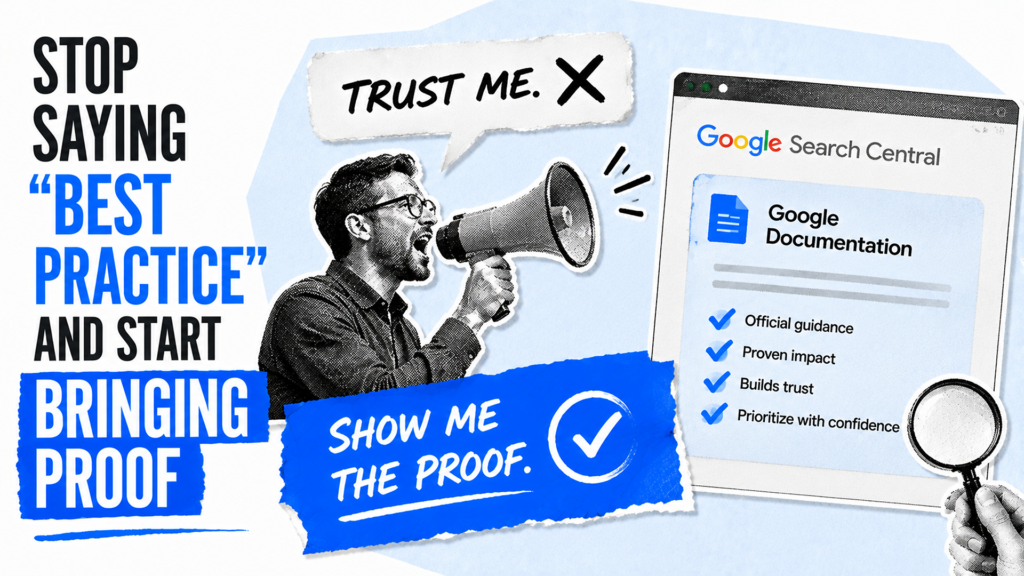
When you need buy-in, sometimes the best argument is not “trust me.”
It’s “Google already documented how we should approach this.”
The buy-in problem is usually not the recommendation itself
Most SEO recommendations do not die because they are wrong. They die because they have to compete with everything else happening inside the business.
Dev sprints, product timelines, CMS limitations, legal concerns, brand standards, executive assumptions, and the ever-popular… (close your eyes!) “we’ve always done it this way”, it all has a seat at the table. SEO is rarely the only priority in the room, even when the recommendation is technically correct.
That is why “best practice says” or “from an SEO perspective” is simply not enough to close the deal. It sounds optional, especially to teams already managing risk, deadlines, and competing requests.
But “Google has official documentation to guide us” lands differently.
It may not automatically win the argument, and it definitely does not mean the recommendation gets prioritized tomorrow. But it does change the conversation from “the SEO gal told us…” to “Suzzie provided us official Google documentation explaining why this matters.”
Google documentation is not gospel
I know what some of you are thinking.
“Nick, are we really pretending Google tells us the full truth about how search works?”
Fuck No. I mean… absolutely not.
Google’s documentation is not the complete truth of search. It has omissions. It simplifies complicated systems. Sometimes it explains how Google wants site owners to behave, not necessarily every nerdy factor that goes into organic visibility.
Google also writes documentation for a very broad audience. That means nuance gets sanded down, edge cases get skipped, and the answer is often technically true without being the entire story. (Want proof? Log in to X, and you’ll read SEOs with too much time on their hands, complaining and “calling out” Google for this)
So no, I am not suggesting we treat every Google statement as if it were carved into stone tablets and carried down from Mountain View.
But…
Source link
Disclaimer
We strive to uphold the highest ethical standards in all of our reporting and coverage. We blogs.grocliq.com want to be transparent with our readers about any potential conflicts of interest that may arise in our work. It’s possible that some of the investors we feature may have connections to other businesses, including competitors or companies we write about. However, we want to assure our readers that this will not have any impact on the integrity or impartiality of our reporting. We are committed to delivering accurate, unbiased news and information to our audience, and we will continue to uphold our ethics and principles in all of our work. Thank you for your trust and support.
Website Upgradation is going on for any glitch kindly connect at [email protected]