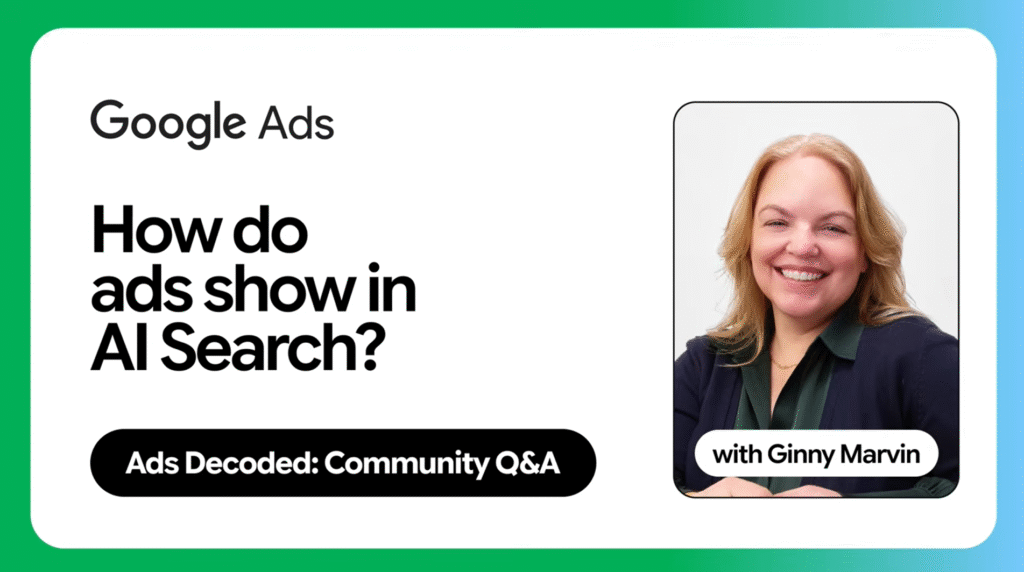

Google Ads Liaison Ginny Marvin addressed several advertiser questions about AI Search, Qualified Future Conversions (QFC), and YouTube Creator Partnerships in the latest edition of the Ads Decoded newsletter and accompanying video.
The community Q&A followed Google Marketing Live and focused on topics that have generated ongoing questions from advertisers, including AI Search eligibility, long-term conversion measurement, and creator partnerships.
None of Marvin’s answers introduced new product announcements. Instead, they added context to features Google announced at GML and reinforced how Google expects advertisers to use them.
Google Clarifies How Ads Become Eligible For AI Search
One of the most common questions Marvin received was how advertisers can make their ads eligible to appear in AI Overviews and AI Mode.
Her answer was that nothing has changed.
Advertisers still need to use Google’s AI-powered targeting solutions, including Broad Match or keywordless targeting through AI Max, Performance Max, Shopping campaigns, and Dynamic Search Ads as they transition to AI Max. Smart Bidding also remains part of that requirement.
While that wasn’t new information, Marvin spent more time explaining why Google continues emphasizing AI Max and Performance Max.
According to Marvin:
Keep in mind that the relevance bar is higher in AI Search, and ads are matched to Google’s understanding of the user intent based on both the user query and the content in the response.
As search behavior becomes longer, more conversational, and increasingly multimodal, Google’s systems use that additional context to determine which ads are most relevant.
Marvin pointed to AI-powered matching and text customization as two reasons those campaign types remain central to AI Search. Text customization helps tailor ad copy to better match the surrounding conversation, while Final URL Expansion can direct users to the landing page Google determines is most relevant to their intent.
She also highlighted several controls available in AI Max, including:
- Brand controls
- Location-of-interest settings
- URL inclusions and exclusions
Marvin added that AI Brief is expected to roll out in English in the coming months, allowing advertisers to provide messaging, audience, and matching guidance using natural language.
What This Suggests About Google’s Direction
Although Marvin said nothing has changed from an eligibility standpoint, the discussion reinforced Google’s recent messaging around AI-powered campaign management.
AI Max, Broad Match, Smart Bidding, text customization, and Final URL Expansion were all referenced as technologies that support AI Search experiences. If advertisers are less willing to adopt these AI features, their ad eligibility could potentially be less competitive than other advertisers who are utilizing Google’s full AI suite of tools.
Marvin also clarified that Google’s systems evaluate both the user’s query and the AI-generated response…
Source link
Disclaimer
We strive to uphold the highest ethical standards in all of our reporting and coverage. We blogs.grocliq.com want to be transparent with our readers about any potential conflicts of interest that may arise in our work. It’s possible that some of the investors we feature may have connections to other businesses, including competitors or companies we write about. However, we want to assure our readers that this will not have any impact on the integrity or impartiality of our reporting. We are committed to delivering accurate, unbiased news and information to our audience, and we will continue to uphold our ethics and principles in all of our work. Thank you for your trust and support.
Website Upgradation is going on for any glitch kindly connect at [email protected]