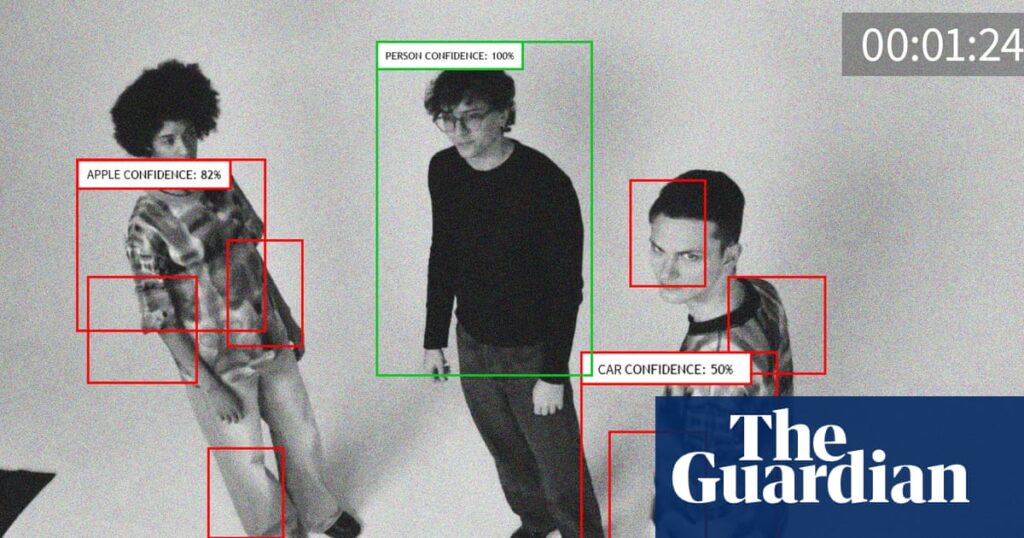

As facial recognition technology is rolled out across Britain’s public spaces, a new generation of designers say privacy could be the next big fashion trend.
Companies have started incorporating “adversarial patterns” in their garments – carefully designed arrangements of shapes, colours and repeated motifs said to exploit weaknesses in some computer vision systems.
The designers say advances in computing have made it easier to incorporate such patterns into commercially viable garments. Experts caution that the effectiveness of the patterns depends on the surveillance system and the conditions in which it is used, but Nick Tidball, the co-founder of the clothing brand Vollebak, thinks “adversarial clothing” could be on the cusp of going mainstream.
“Anti-surveillance feelings are so widespread that all it would take is for a single celebrity to wear one of these garments, currently popular in the countercultural fashion world, to a high-profile event for it to take off,” he said.
“So-called ‘adversarial clothing’ wins on many levels. As well as the practicality of protection, it’s fashionable and fun, it makes a powerful, public statement that many are in agreement with, it spreads even more awareness about the importance of privacy and it helps encourage public debate.”
Unlike traditional CCTV, modern computer vision systems can identify faces, follow individuals across cameras and search footage at scale.
Recent advances in generative AI have made this type of automated identification cheaper and more widely available to police, retailers and private businesses, an expansion recently warned against by Britain’s biometrics watchdogs, which have called for more laws and a regulator to clamp down on misuse.
Evidence of misuse and that black and Asian people are more likely to be incorrectly identified than white people has led to increasing public concern. A recent poll showed almost 60% of people believed facial recognition was “another step towards turning the UK into a surveillance society”.
Dr Jennifer Bell, a senior lecturer specialising in creative AI, fashion and digital culture at Nottingham School of Art & Design, said clothing with anti-facial recognition designs was increasingly available at high street prices and was being marketed to a wide demographic. “That growing awareness combined with a lowering of cost often precedes the tipping point towards a real cultural moment,” she said.
Daniel Preuß, the co-founder of the Urban Privacy clothing brand, said new technology meant you could now “combine smart, striking style with invisible protection”.
He emphasised that because surveillance systems are so powerful, no design can guarantee security from detection, but said “the added value of fashion is to spread awareness and…
Source link
Disclaimer
We strive to uphold the highest ethical standards in all of our reporting and coverage. We blogs.grocliq.com want to be transparent with our readers about any potential conflicts of interest that may arise in our work. It’s possible that some of the investors we feature may have connections to other businesses, including competitors or companies we write about. However, we want to assure our readers that this will not have any impact on the integrity or impartiality of our reporting. We are committed to delivering accurate, unbiased news and information to our audience, and we will continue to uphold our ethics and principles in all of our work. Thank you for your trust and support.
Website Upgradation is going on for any glitch kindly connect at [email protected]