
60% of Google searches now end without a click to any content.
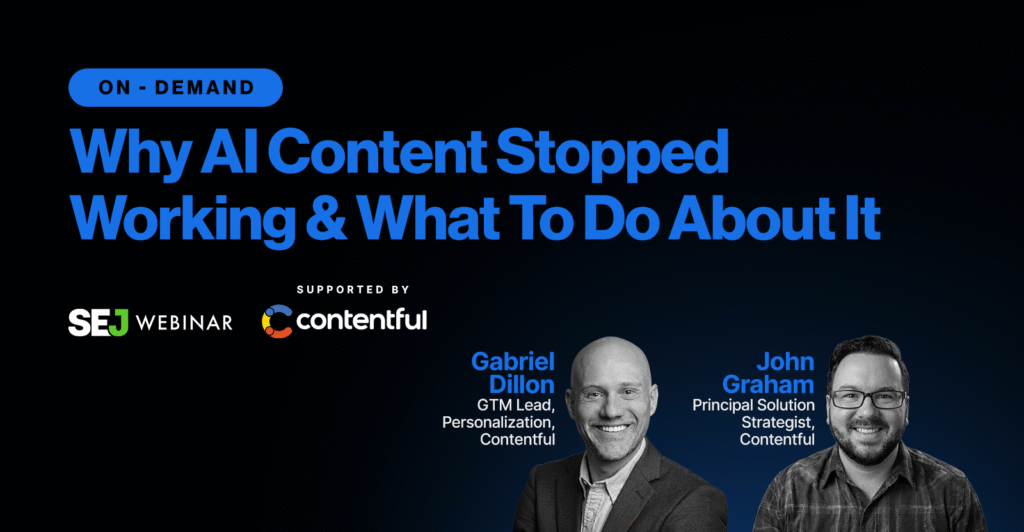
That stat framed the core argument from Gabriel Dillon, Go-to-Market Lead for Personalization at Contentful: when AI makes content nearly free to produce, volume stops being a strategy. The only content that earns attention is content held accountable to a business outcome, built for a specific human, and measured against real data.
In an SEJ webinar with Contentful Principal Solution Strategist John Graham, Dillon walked through why AI-assisted copy drifts toward generic output, the four questions he runs on every piece of marketing copy before it ships, and the personalization signals that work without overcomplicating your stack.
The session also covered where the human belongs in an AI-assisted workflow, and how experimentation and personalization combine into an accountability loop for content performance.
Watch the full webinar on demand.
Why Your AI Content Sounds Like Everyone Else’s
Your AI writing assistant acts as the ultimate yes man, and your own assumptions feed the loop. That is Dillon’s explanation for why every brand’s AI-assisted copy converges on the same output.
“Our biases as we write content using the robots ends up eating the content that we produce,” he said. “We end up in this cycle of creating content that we think is good but doesn’t actually do what we think it does.”
The copy that comes back either confirms what you already believed or mirrors every competitor’s blog in the tool’s training data. Both outcomes fail the reader.
Dillon’s counterweight is taste, and he pushed the definition past the cliche: discernment and intuition, plus the risk-taking to make a claim no AI tool would volunteer, based on what you actually know about your market.
The session mapped exactly where the human steps into the AI-assisted workflow, between AI as a research and context layer and the copy that ships.
How Do You Hold Content Accountable For Business Outcomes?
Dillon runs the same four questions on every piece of B2B marketing copy before it ships.
The first is whether the copy produces the outcomes you expect. The other three cover who the content is for, how you identify those people, and how the insight scales.
“If we don’t have data that proves that our content is good, then we can’t really think about the way to scale it out or make it more effective,” he said.
Experimentation and personalization are two halves of the same coin in this model. How the two combine into a system, rather than a series of one-off tests, is where the recording goes deep.
The full walkthrough diagrams the accountability loop and the experiment dimensions beyond variant A vs. variant B.
Action item: before commissioning the next batch of AI content, run it against Dillon’s four accountability questions.
Which Personalization Signals Work Without Overcomplicating Your Stack?
The signals your stack already collects. Dillon’s diagnosis of why B2B…
Source link
Disclaimer
We strive to uphold the highest ethical standards in all of our reporting and coverage. We blogs.grocliq.com want to be transparent with our readers about any potential conflicts of interest that may arise in our work. It’s possible that some of the investors we feature may have connections to other businesses, including competitors or companies we write about. However, we want to assure our readers that this will not have any impact on the integrity or impartiality of our reporting. We are committed to delivering accurate, unbiased news and information to our audience, and we will continue to uphold our ethics and principles in all of our work. Thank you for your trust and support.
Website Upgradation is going on for any glitch kindly connect at [email protected]