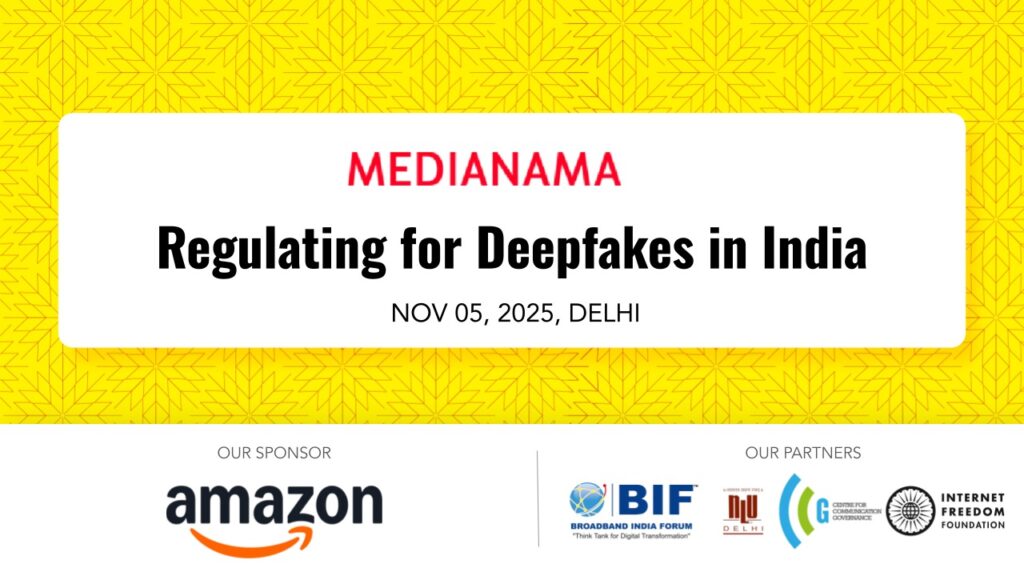

“Let’s say if I get on a live. Now there are AI avatars that people can create and they can distribute through, like an Instagram live. I’m not taking names of products, but there are ephemeral products through which a lot of these things can be done. How do you do provenance checking then? How do you do labelling there if the user is declaring, [or even if they are] not declaring?” a participant at MediaNama’s discussion ‘Regulating for Deepfakes in India’ pointed out last week.
This participant was specifically commenting on social media platform-level challenges in implementing labelling.
For context, MediaNama’s discussion focused on a draft amendment to the Information Technology (Intermediary Guidelines and Digital Media Ethics Code) Rules, 2021. This amendment aims to legally define synthetically generated information, mandate labelling, watermarking, and metadata embedding for such content, require user declarations and automated verification by Significant Social Media Intermediaries (SSMIs), and extend due diligence obligations for intermediaries that facilitate or host synthetic content.
[Note: While most of the deliberation took place under the Chatham House Rule, participants in Session 1 “Impact of the Regulation on Businesses and Technical Challenges for Implementation”, which focused on the perspectives of businesses using AI to provide their services, chose to waive the rule.]How would AI service providers handle live content requirements?
The draft rules state that intermediaries where users can create, modify, or alter synthetically generated information must add prominent, unique metadata or identifiers to the information. This identifier must cover at least 10% of the visual display, or, in the case of audio content must be present during at least 10% of the duration.
AI service providers argued that it would be hard to pre-emptively identify the length of a live piece of content and add labels that occupy 10% of the visual display/audio duration. “If you ask me what is 10% of a live stream call, I don’t know. I can only tell you after the call ends, right? But even if I were to give the benefit of doubt, and say add in the first 10 seconds of the call itself that ‘Hi, I am an AI-generated voice’, it ruins the user experience. It ruins the user experience and creates a sort of untrustworthiness for the brand, the business that is using it,” Poushali Dutta, Co-Founder of OttrCall, mentioned during the discussion.
For context, OttrCall is a business-to-business (B2B) software-as-a-service (SaaS) company that helps businesses create AI voice agents that can act as 24-hour call centres.
Similarly, Abhishek Nevatia, the founder of live shopping marketplace Zoop, also highlighted the challenges of implementing labels in live content. Explaining Zoop’s services, Nevatia mentioned that the company allows sellers to promote/sell their products over live video. When…
Source link
Disclaimer
We strive to uphold the highest ethical standards in all of our reporting and coverage. We blogs.grocliq.com want to be transparent with our readers about any potential conflicts of interest that may arise in our work. It’s possible that some of the investors we feature may have connections to other businesses, including competitors or companies we write about. However, we want to assure our readers that this will not have any impact on the integrity or impartiality of our reporting. We are committed to delivering accurate, unbiased news and information to our audience, and we will continue to uphold our ethics and principles in all of our work. Thank you for your trust and support.
Website Upgradation is going on for any glitch kindly connect at [email protected]