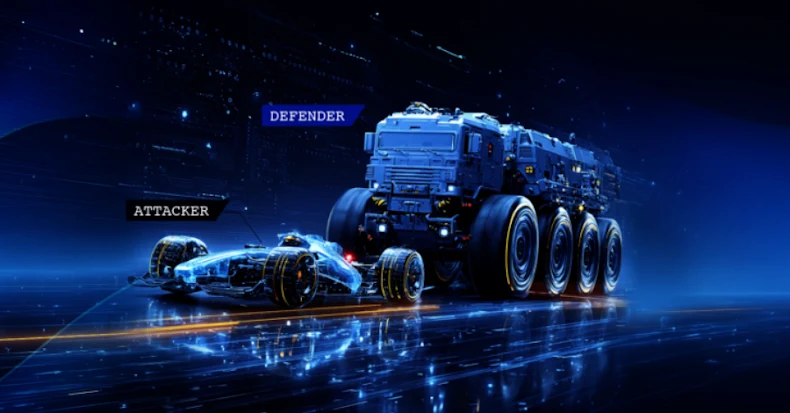


The Race for Every New CVE
Based on multiple 2025 industry reports: roughly 50 to 61 percent of newly disclosed vulnerabilities saw exploit code weaponized within 48 hours. Using the CISA Known Exploited Vulnerabilities Catalog as a reference, hundreds of software flaws are now confirmed as actively targeted within days of public disclosure. Each new announcement now triggers a global race between attackers and defenders. Both sides monitor the same feeds, but one moves at machine speed while the other moves at human speed.
Major threat actors have fully industrialized their response. The moment a new vulnerability appears in public databases, automated scripts scrape, parse, and assess it for exploitation potential, and now these efforts are getting ever more streamlined through the use of AI. Meanwhile, IT and security teams often enter triage mode, reading advisories, classifying severity, and queuing updates for the next patch cycle. That delay is precisely the gap the adversaries exploit.
The traditional cadence of quarterly or even monthly patching is no longer sustainable. Attackers now weaponize critical vulnerabilities within hours of disclosure, long before organizations have even analyzed or validated them, and usually well before they have rolled out the fix.
The Exploitation Economy of Speed
Today’s threat ecosystem is built on automation and volume. Exploit brokers and affiliate groups operate as supply chains, each specializing in one part of the attack process. They use vulnerability feeds, open-source scanners, and fingerprinting tools to match new CVEs against exposed software targets. Many of these targets have already been identified, and these systems know in advance which targets are most likely to be susceptible to the impending attack. This is a game of quick draw, the fastest gun wins.
Research from Mandiant shows that exploitation often begins within 48 hours of public disclosure, in many organizations, IT operates on 8 hours a day, leaving the 32 hours in the attackers’ favor. This efficiency in operations illustrates how attackers have stripped almost every manual step from their workflow. Once a working exploit is confirmed, it’s packaged and shared within hours across dark web forums, internal channels, and malware kits.
Failure at Scale is Acceptable
Attackers also enjoy a luxury defenders can’t afford: failure. If they crash a thousand systems on the path to compromising a hundred, the effort is still a success. Their metrics are based on yield, not uptime. Defenders, on the other hand, must achieve near-perfect stability. A single failed update or service interruption can have a widespread impact and cause loss of customer trust. This imbalance allows adversaries to take reckless risks while defenders remain constrained, and that also helps keep the operational gap wide enough for consistent exploitation.
From Human-Speed Defense to Machine-Speed Resilience
Awareness is not the issue. The challenge is…
Source link
Disclaimer
We strive to uphold the highest ethical standards in all of our reporting and coverage. We blogs.grocliq.com want to be transparent with our readers about any potential conflicts of interest that may arise in our work. It’s possible that some of the investors we feature may have connections to other businesses, including competitors or companies we write about. However, we want to assure our readers that this will not have any impact on the integrity or impartiality of our reporting. We are committed to delivering accurate, unbiased news and information to our audience, and we will continue to uphold our ethics and principles in all of our work. Thank you for your trust and support.
Website Upgradation is going on for any glitch kindly connect at [email protected]